

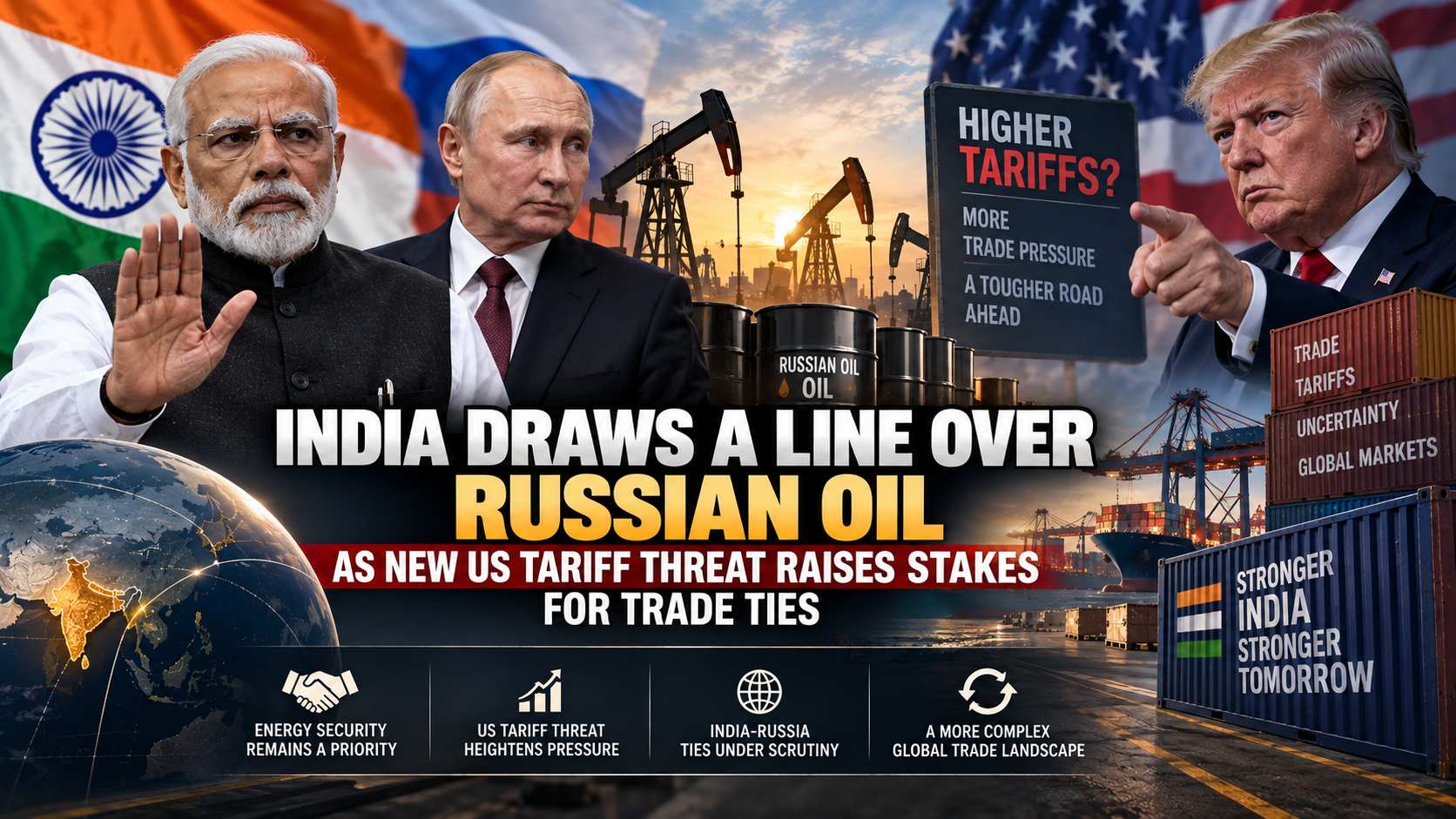
India and the United States are facing a new point of friction, and this time the disagreement is centered on something that keeps India’s economy moving: oil.
New Delhi has warned Washington that proposed U.S. tariffs targeting countries that continue buying Russian energy could have implications for bilateral relations. At the same time, India says it remains committed to securing reliable and affordable energy for its 1.4 billion people.
The warning came after the U.S. House of Representatives passed legislation that would give President Donald Trump broad authority to impose steep tariffs on major buyers of Russian oil and gas, including India. The legislation has been sent to Trump, but it is not yet the same thing as a tariff already being imposed on Indian goods.
That distinction matters because the next stage could determine whether this becomes another negotiating issue between Washington and New Delhi—or a much broader economic dispute.
Why Russian Oil Has Become the Flashpoint
India has become one of the world’s largest buyers of Russian crude since Western sanctions disrupted Russia’s traditional energy markets after the 2022 invasion of Ukraine.
For Indian refiners, Russian oil has often been commercially attractive because of its availability and pricing. New Delhi has repeatedly argued that its energy purchases are guided by national requirements, market conditions and the need to keep energy supplies secure.
Washington takes a different view.
The United States and its allies have sought to reduce Russia’s ability to earn revenue from energy exports, arguing that those revenues help finance Moscow’s war effort in Ukraine.
The new U.S. legislation is therefore designed to put pressure not only on Russia itself, but also on major countries that continue purchasing Russian energy.
India Says Energy Security Comes First
India’s foreign ministry responded carefully but firmly.
New Delhi said it had already discussed the potential consequences of the U.S. measures with American officials and had clearly explained how they could affect both the bilateral relationship and international energy markets.
India also said it would take necessary steps to protect its trade and economic interests while continuing to source energy from diverse suppliers according to market conditions.
The message is significant.
India is not saying that its energy policy cannot change. Rather, it is emphasizing that decisions about where to buy crude will remain closely connected to India’s domestic energy requirements.
With India importing the vast majority of the crude it consumes, changing suppliers is not as simple as switching from one brand to another.
The 100% Tariff Number Needs Context
The phrase “100 percent tariff” is likely to attract headlines, but it needs some explanation.
The legislation passed by the House would authorize tariffs of up to 100% on goods from major purchasers of Russian energy. It does not automatically mean India will immediately face a 100% tariff on all exports to the United States.
The legislation gives the U.S. president significant discretion over whether and how to use the authority. It also contains provisions allowing sanctions or tariffs to be waived in certain circumstances, including where the president determines that doing so is in the U.S. national interest.
That leaves considerable uncertainty.
The immediate question is no longer simply whether Washington wants to pressure Russian oil buyers. It is whether the White House ultimately uses the new authority against India—and, if it does, at what level.
Indian Refiners Are Already Watching the Clock
The issue is particularly sensitive for India’s refining industry.
Reuters reported that Indian refiners have already arranged crude purchases for September and October that include Russian oil. Refining sources have warned that sharply restricting those supplies could increase costs at a time when global oil markets are already dealing with significant disruptions.
That creates a difficult calculation.
If Indian refiners suddenly have to replace large volumes of Russian crude, they may turn toward suppliers in the Middle East, the United States, Africa or elsewhere.
But alternative barrels may be more expensive.
Transportation costs, insurance, crude quality and refining requirements can all change the economics.
In other words, reducing Russian oil purchases is not simply a foreign-policy decision. It can become an input-cost decision for India’s entire energy system.
Higher Oil Costs Could Travel Through the Economy
The consequences could eventually reach consumers.
Crude oil is a fundamental input for transportation, manufacturing, aviation, chemicals and many other industries.
If replacement oil becomes significantly more expensive, refiners could face tighter margins or pressure to pass some of the additional cost through the fuel market.
That does not mean petrol and diesel prices would automatically rise by a particular amount. India’s retail fuel prices also depend on taxes, refining margins, currency movements and domestic pricing decisions.
But the basic economic risk is straightforward: a more expensive barrel can eventually make many parts of the economy more expensive.
The U.S.-India Trade Relationship Adds Another Layer
Oil is only one part of the dispute.
India and the United States have also been negotiating a broader trade agreement, making the timing particularly sensitive.
Reuters reported that Indian analysts expect the possibility of additional U.S. tariffs to complicate those negotiations. India’s Trade Minister Piyush Goyal is due to travel to the United States later in September for a G20 trade ministers’ meeting, where discussions with U.S. Trade Representative Jamieson Greer are expected.
That means the Russian-oil dispute could spill into other areas.
A disagreement over energy could influence negotiations on tariffs, market access and other trade issues.
At the same time, Washington has its own interest in maintaining a substantial economic relationship with India.
The United States is India’s largest export destination, with Indian goods shipments to the U.S. rising to $42.79 billion during April-August, up from $40.39 billion a year earlier, according to Reuters.
India Has Already Been Under Pressure to Reduce Russian Oil
This is not a completely new disagreement.
Earlier in 2026, Trump announced a trade arrangement under which the United States would reduce tariffs on Indian goods after India committed to stop buying Russian oil and take other steps related to trade. However, Russian crude has continued to feature in Indian refinery procurement.
That history makes the latest legislation particularly significant.
Washington has already tried diplomatic and trade pressure.
The new legislation potentially adds another instrument: tariffs on countries that continue buying Russian energy.
For New Delhi, that raises the stakes considerably.
Why India May Resist a Sudden Shift
India’s argument is largely based on scale.
The country is one of the world’s biggest oil importers, and its demand continues to rise as its economy and population expand.
For India, the central question is not only where the crude comes from.
It is whether enough crude can be obtained at prices that do not place excessive pressure on consumers, industry and the country’s trade balance.
India therefore has an incentive to maintain multiple sources of supply.
Russia is one part of that strategy, alongside Middle Eastern producers and other international suppliers.
That diversification gives Indian refiners more choices when geopolitical conditions change.
Russia Is Also Adapting to the Pressure
The other side of the equation is Moscow.
Western sanctions have forced Russia to redirect much of its energy trade toward countries such as India and China.
If major buyers reduce purchases, Russia could face additional pressure to find alternative markets or accept lower prices.
That is precisely the broader objective behind measures targeting buyers of Russian energy.
But there is a potential side effect.
If Russian crude is removed from the market too quickly, global oil supplies could tighten, particularly if other producers cannot immediately replace the lost barrels.
Higher global oil prices could then partially offset the intended pressure on Russia by making every remaining barrel more valuable.
India has explicitly warned that the consequences could extend beyond its own economy to the international energy market.
This Is a Balancing Act for Washington Too
For the Trump administration, the calculation is not straightforward either.
Washington wants to increase economic pressure on Russia.
But it also has a major strategic and economic relationship with India.
Punishing Indian exports could affect American businesses and consumers as well as Indian companies.
It could also complicate cooperation between Washington and New Delhi in areas extending far beyond energy, including technology, defense, manufacturing and supply-chain diversification.
That does not mean the United States will abandon the tariff approach.
It means the economic pressure comes with diplomatic costs that policymakers must weigh.
What Happens Next?
The immediate focus is on the U.S. legislation.
The House has passed the measure, and it has been sent to Trump. Whether it becomes law in its current form, whether the administration uses its tariff authority, and whether India receives any exemption or transition period remain important unanswered questions.
Indian refiners, meanwhile, will continue watching the price and availability of Russian crude alongside alternative supplies.
For New Delhi, the challenge is to protect energy security without allowing the dispute with Washington to escalate into a wider trade confrontation.
For Washington, the challenge is different: pressure Russia without unnecessarily damaging an important relationship with India or creating another shock in global oil markets.
The Real Battle Is Over Who Bears the Cost
The dispute may ultimately come down to a question much bigger than Russian oil itself: who pays the price for geopolitical pressure?
If India reduces Russian purchases quickly, its refiners may have to pay more for replacement barrels.
If Washington imposes severe tariffs, Indian exporters could face higher costs in the U.S. market.
If Russia loses major buyers, Moscow could face greater financial pressure—but global oil prices could also respond to the reduction in supply.
And if the disagreement spills into broader trade negotiations, both countries could face economic consequences beyond the energy sector.
For now, India has drawn a clear line: it intends to protect its energy and economic interests and has warned Washington that the new measures could affect bilateral ties.
The next move belongs largely to Washington.
And the question is no longer whether Russian oil is a source of tension between India and the United States.
It is how far that tension will spread.









Leave a Reply