

For years, parents have been told to monitor what their children do online. Check the apps. Limit screen time. Turn on parental controls. Watch what they watch.
The European Union now wants to change that equation.
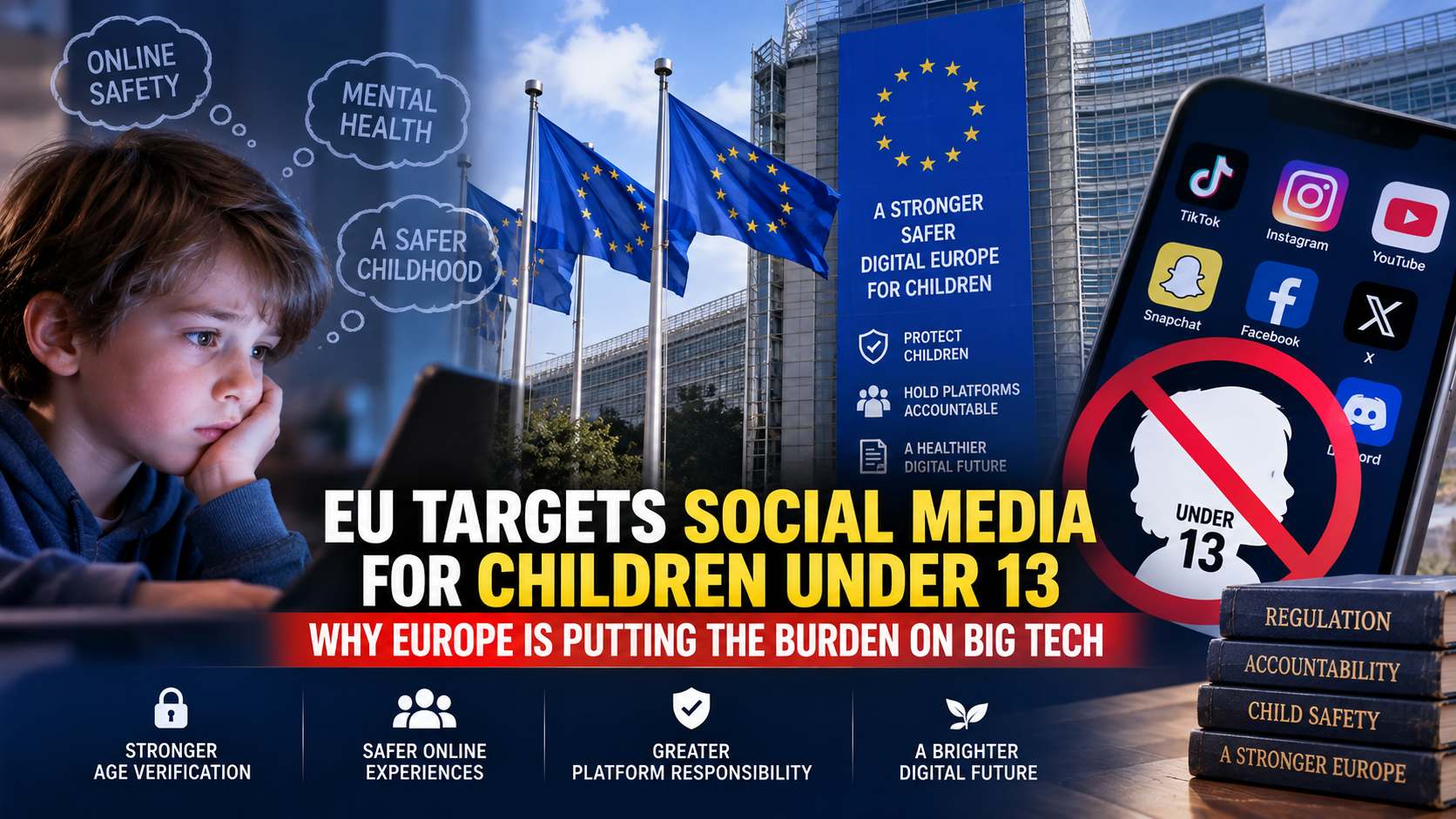
The European Commission has proposed the EU KIDS Act, a sweeping set of rules designed to create stronger protections for children across digital services. At the center of the proposal is a ban on social media access for children under 13, tighter controls for teenagers, and a new expectation that technology companies—not parents alone—must prove their services are safe for young users.
The proposal could eventually affect how children use platforms such as Instagram, Facebook, TikTok and YouTube, as well as online games and AI-powered chatbots designed for younger users.
But the bigger story is not simply about an age limit. It is about who should carry the responsibility when digital products are designed to keep people scrolling.
What the EU Is Actually Proposing
Under the KIDS Act, children under 13 would not be allowed to have social media accounts. Young teenagers aged 13 and 14 would not receive unrestricted accounts either.
Instead, they could use limited “mini accounts” supervised by a parent or guardian. The European Commission says these accounts would have restricted features and a maximum daily usage period of one hour for social media and video-sharing services. Independent personal accounts would become available from age 15.
That means the proposal creates three broad stages rather than simply switching social media on or off.
Under 13 would mean no social media accounts. Ages 13 and 14 would receive supervised and restricted access. From 15, young people could have their own accounts, but platforms would still have to follow stronger child-safety requirements.
It is a gradual approach designed around age rather than treating every minor in exactly the same way.
This Is Bigger Than a Social Media Ban
Calling the proposal a “social media ban” captures the headline but misses much of the legislation.
The Commission also wants stronger protections for minors across video-sharing services, online games, AI companions and chatbots offering services to children. Platforms would be expected to remove or restrict features considered particularly risky for young users.
Those measures include restrictions on addictive design features, profiling-based recommendation feeds, infinite scrolling, reward mechanisms and unsolicited contact from strangers.
AI companions and chatbots aimed at children would also have to be switched off by default.
In other words, Brussels is not only asking, “How old are you?”
It is also asking, “What happens after you get through the digital front door?”
Europe Wants Platforms to Prove They Are Safe
Perhaps the most significant change is the Commission’s proposed shift in responsibility.
Traditionally, parents have been expected to manage much of the risk. The new approach would put more responsibility on platforms to demonstrate that their products are safe for children.
The Commission describes this as reversing the “burden of proof.” Instead of regulators having to discover harmful design practices after they cause problems, platforms would have to demonstrate that their services are appropriate and safe by design.
That could represent a major change in the relationship between regulators and technology companies.
Think of it like a car manufacturer. Instead of telling parents to drive more carefully around an unsafe vehicle, regulators are asking the manufacturer to make the vehicle safer before it reaches the road.
Age Verification Will Become a Major Test
There is, however, a difficult practical question hiding behind the age limits: How does a platform know whether someone is 12, 14 or 25?
The Commission wants platforms to use certified age-verification systems. The EU has already been developing privacy-focused technology intended to allow users to prove their age without necessarily handing platforms unnecessary personal information.
The Commission says its approach is based on privacy-preserving “proof of age” technology.
That could help address one of the biggest concerns surrounding online age checks. A system designed to protect children should not create a new problem by forcing millions of people to submit more personal information to social media companies.
The success of the KIDS Act could therefore depend as much on implementation as on the headline age limit.
The One-Hour Rule Changes the Conversation
For 13- and 14-year-olds, the proposal goes beyond parental permission.
The planned mini accounts would come with limited features and a daily usage limit of up to one hour on social media and video-sharing services. Parents or guardians would have control over these accounts.
That is important because the EU is targeting not just what children see but how digital platforms encourage them to remain engaged.
Infinite scroll, recommendation systems and reward mechanisms can make an ordinary five-minute visit turn into an hour-long session. The Commission wants platforms to change those design choices rather than simply asking families to exercise more self-control.
Why the EU Is Acting Now
The proposal arrives amid growing international concern about children’s experiences online.
Governments in several countries have introduced or considered stronger age restrictions, while researchers, parents and policymakers continue debating the effects of social media and other digital services on young people.
The European Commission has also been working on age-verification technology and broader digital-safety measures.
The EU’s argument is essentially that today’s digital environment was not originally built around children’s developmental needs.
Von der Leyen has argued that parents should not be expected to compete with sophisticated algorithms on their own.
That idea sits at the heart of the new proposal.
The Biggest Challenge May Be Enforcement
Writing a rule is one thing. Making it work online is another.
Children can lie about their age. Accounts can be shared. New platforms can appear. Services can operate across borders. Parents may disagree about restrictions, while teenagers may look for ways around them.
Australia’s experience with its own under-16 social media restrictions has already highlighted how complicated enforcement can become, according to Reuters.
Europe will therefore face a basic technology problem: an age limit is only as effective as the system used to enforce it.
There is also a privacy question. Age verification may protect children, but regulators must ensure that the process does not encourage companies to collect excessive amounts of sensitive personal information.
Technology Companies Are Facing a New Regulatory Model
For major technology companies, the proposal could mean more than changing registration screens.
Platforms could have to redesign recommendation systems, parental controls, messaging functions and other features used by minors.
The Commission is also proposing stronger obligations around child-safety plans and safe-by-design principles.
This reflects a wider European regulatory philosophy: if a product creates predictable risks, the company should address those risks in the product itself rather than relying entirely on users to protect themselves.
That approach could eventually influence digital services beyond children’s accounts.
The Proposal Still Has a Long Road Ahead
The KIDS Act is a proposal, not an enforceable EU-wide ban today.
It must be negotiated with EU member states and the European Parliament, meaning parts of the proposal could change before any final legislation is adopted.
That distinction matters.
For now, families in Europe do not suddenly lose access to social media because of the Commission’s announcement. The proposal begins a legislative process that could ultimately establish common rules across the bloc.
Europe Is Asking a Bigger Question About the Internet
The most interesting part of the KIDS Act may ultimately have little to do with the number 13.
The deeper question is whether digital platforms should be allowed to operate largely the same way for children as they do for adults.
Europe’s answer appears to be no.
The proposed system would combine age restrictions, parental supervision, privacy-conscious age verification and design requirements intended to make digital services safer for minors.
If adopted, the rules would place a greater share of responsibility on technology companies to build safer digital environments from the beginning.
That could make the debate much bigger than a simple social media ban. The EU is effectively testing a new idea: when technology is powerful enough to shape children’s behavior, should the technology itself carry more responsibility for the consequences?
The answer will be debated in Brussels in the months ahead. But the direction is already clear—the EU wants child safety to become a design requirement, not just a parental responsibility.










Leave a Reply