

Japan has spent decades trying to escape deflation. Now its central bank is facing a very different problem: prices are rising enough that policymakers are worried inflation could become harder to control.
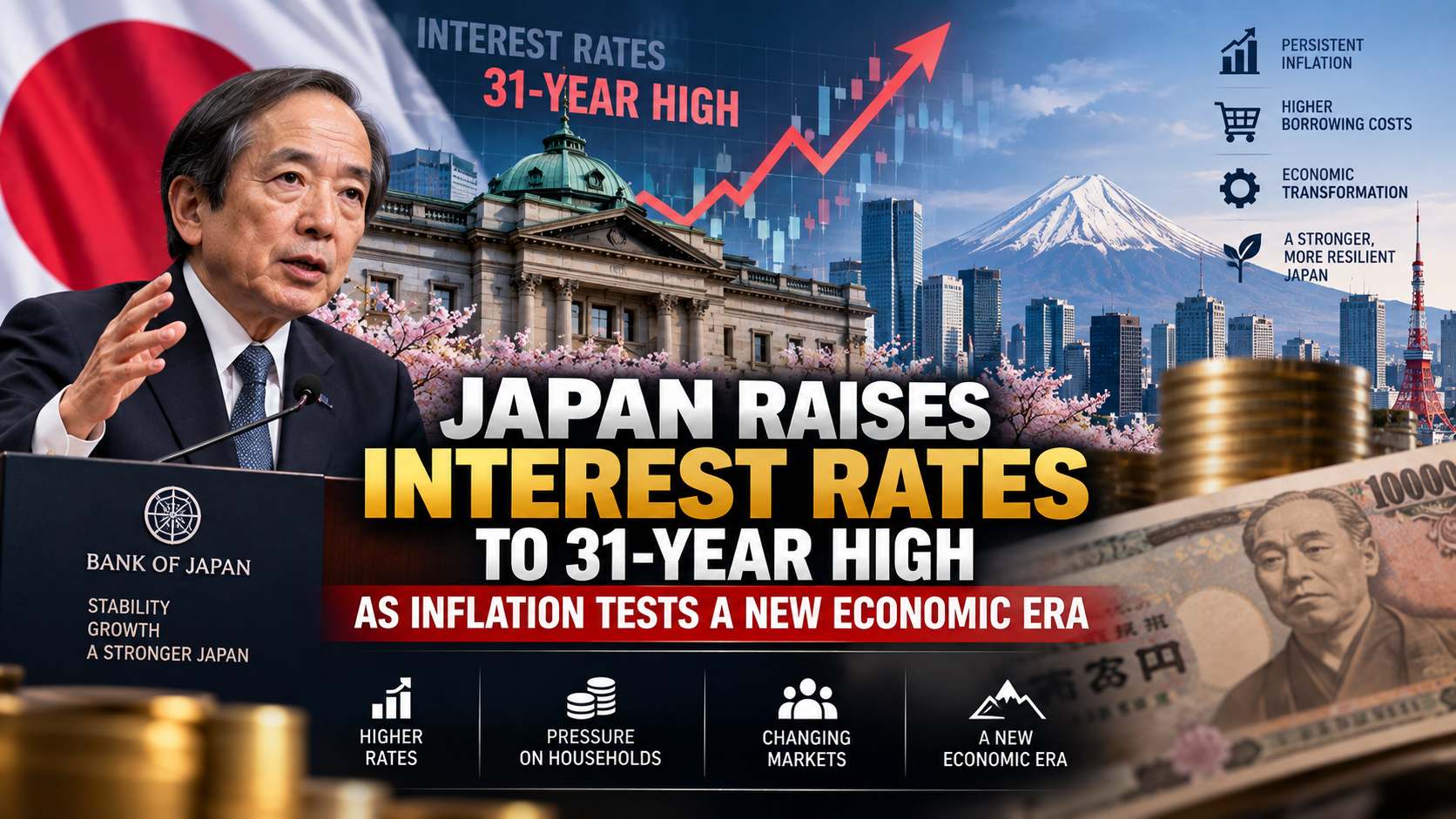
The Bank of Japan raised its benchmark interest rate from 1% to 1.25% on September 18, taking borrowing costs to their highest level in 31 years. The decision was approved by a 7–2 vote and was widely expected by financial markets.
The increase may look small compared with interest rates in many other major economies. But for Japan, where borrowing costs remained at or below zero for years, it represents another major step away from an era of extraordinarily cheap money.
And that transition is not happening in a vacuum. Japan is dealing with higher energy costs, a weaker yen and changing global economic conditions.
Why Did the Bank of Japan Raise Rates Again?
The immediate concern is inflation.
Japan’s inflation rate is currently around the Bank of Japan’s 2% target, but policymakers are increasingly concerned about risks that prices could accelerate further. Higher energy costs, exchange-rate movements and stronger demand in some areas of the economy are contributing to those concerns.
The war involving Iran has added another complication.
Japan imports virtually all of its oil, meaning a prolonged increase in global energy prices can quickly raise costs for households and businesses. Higher fuel prices can then feed into transportation, manufacturing, food and other everyday expenses.
The BOJ therefore faces a difficult calculation: allow rates to remain too low and inflation could become more persistent, or raise rates too quickly and risk weakening an economy that is still adjusting to higher borrowing costs.
Japan Is Moving Further Away From the Zero-Rate Era
To understand why the latest decision matters, it helps to remember where Japan came from.
After the collapse of its asset bubble in the early 1990s, Japan struggled with weak growth and prolonged deflation. The country spent years using extremely low interest rates and other monetary measures to encourage borrowing, investment and spending.
The BOJ eventually introduced negative interest rates in 2016.
That long experiment began to change in 2024, when the central bank ended its negative-rate policy. Rates have since moved gradually higher as officials became more confident that Japan could sustain a more normal inflation environment.
The latest increase therefore represents another step in a much longer policy transformation.
Japan is effectively trying to learn how to operate in an economy where inflation, rather than falling prices, is once again a central concern.
But Higher Rates Do Not Automatically Make Prices Fall
There is an important complication.
Much of the recent inflation pressure has come from higher import and production costs rather than an overheating economy alone.
That makes the BOJ’s job particularly difficult.
If oil becomes more expensive because of geopolitical conflict, raising Japanese interest rates cannot directly produce more oil. If the yen weakens and imported goods become more expensive, higher borrowing costs may not immediately reverse those supply pressures.
The central bank can, however, influence demand and financial conditions. Higher rates can make borrowing more expensive, discourage excessive spending and investment and potentially support the yen by making Japanese assets more attractive.
In other words, the BOJ is trying to prevent temporary price shocks from turning into a more persistent inflation problem.
The Yen Is Still a Major Part of the Story
Japan’s currency has become one of the most important factors in the inflation debate.
A weaker yen increases the cost of imported goods, particularly energy and raw materials. That matters enormously for a country that relies heavily on imports for its energy needs.
The yen had fallen to around 160 against the U.S. dollar earlier this year before recovering. Recent market movements have also been influenced by expectations about Japanese and U.S. interest rates.
Interestingly, Friday’s rate increase did not immediately strengthen the yen.
Instead, the currency weakened after the BOJ announcement as investors focused on the lack of stronger guidance about future increases and the two dissenting votes.
That reaction highlights an important point: financial markets care not only about today’s interest rate but also about what central bankers signal about tomorrow.
Two BOJ Members Wanted to Wait
The 7–2 vote is one of the more significant details behind the announcement.
Board members Toichiro Asada and Ayano Sato opposed the increase and preferred to keep the policy rate at 1%.
Their dissent matters because it shows that the central bank is not completely united on how quickly monetary policy should tighten.
That uncertainty could influence future decisions.
If inflation continues to rise, pressure for additional increases could grow. But if higher borrowing costs begin to weaken household spending, business investment or economic growth, the BOJ may have reasons to move more cautiously.
The rate decision is therefore not a promise of a rapid series of increases.
Businesses Are Already Feeling the Difference
Japan’s move toward higher rates has consequences for companies.
A Reuters survey published earlier this year found that nearly half of Japanese firms reported negative effects from previous BOJ rate increases. Higher borrowing costs were hurting profits and discouraging some investment.
That creates another balancing act.
Japan wants an economy strong enough to support wages and investment, but it also wants to prevent inflation from becoming entrenched.
For heavily indebted businesses, higher rates can increase financing costs. For savers, however, higher interest rates can provide a benefit that was difficult to obtain during Japan’s ultra-low-rate era.
The effect therefore differs from one household or company to another.
What Does This Mean for Japanese Households?
For ordinary households, the most visible issue remains the cost of living.
Food, fuel, electricity and other necessities have become more expensive, putting pressure on people whose incomes have not risen at the same pace.
Higher interest rates may eventually help contain inflation, but they also make loans and mortgages more expensive.
That means the BOJ’s policy shift comes with a trade-off.
The same medicine that may help prevent prices from accelerating can also make borrowing more costly.
Japan’s policymakers will therefore be watching wages and household spending closely.
Japan Is Also Watching the Rest of the World
The BOJ is not operating alone.
The U.S. Federal Reserve also raised its benchmark rate this week, taking its target range to 3.75%–4%, while other major central banks have been adjusting policy in response to changing inflation and economic conditions.
Differences between Japanese and overseas interest rates have historically encouraged investors to borrow cheaply in Japan and invest in higher-yielding assets elsewhere.
Those so-called carry trades can influence global markets.
As Japanese rates rise, some investors may reconsider whether it remains attractive to borrow in yen.
That means a BOJ decision that appears relatively small from Tokyo can have consequences far beyond Japan.
The Next Move May Be More Important Than This One
Markets had already anticipated Friday’s increase.
The bigger question now is what Governor Kazuo Ueda and the BOJ will do next.
The central bank has signaled that further increases remain possible if the economy and inflation develop in line with its expectations. But the two dissenting votes and the yen’s immediate reaction show that investors are uncertain about the pace of future tightening.
That uncertainty is likely to remain a major theme in Japanese markets.
Another rate increase may come later this year or in 2027, but its timing will depend on inflation, wages, economic growth, exchange rates and global energy prices.
Japan’s Economic Experiment Has Entered a New Phase
The significance of the 1.25% rate is not really the number itself.
It is what the number represents.
For decades, Japan’s central bank fought falling prices and weak demand with extraordinarily loose monetary policy. Now it is gradually tightening policy because inflation has become a risk worth containing.
That does not mean Japan has suddenly become a high-interest-rate economy. Its benchmark remains far below rates in the United States and many other countries.
But the direction has changed.
Japan is moving from an economy accustomed to almost free money toward one where the cost of borrowing once again matters.
The challenge for the BOJ will be making that transition without damaging the recovery it spent decades trying to create.
The latest rate increase shows that the era of ultra-cheap money is moving further into the past. What remains uncertain is how quickly Japan will leave it behind—and whether the country’s households and businesses can comfortably adjust to the new economic reality.










Leave a Reply