

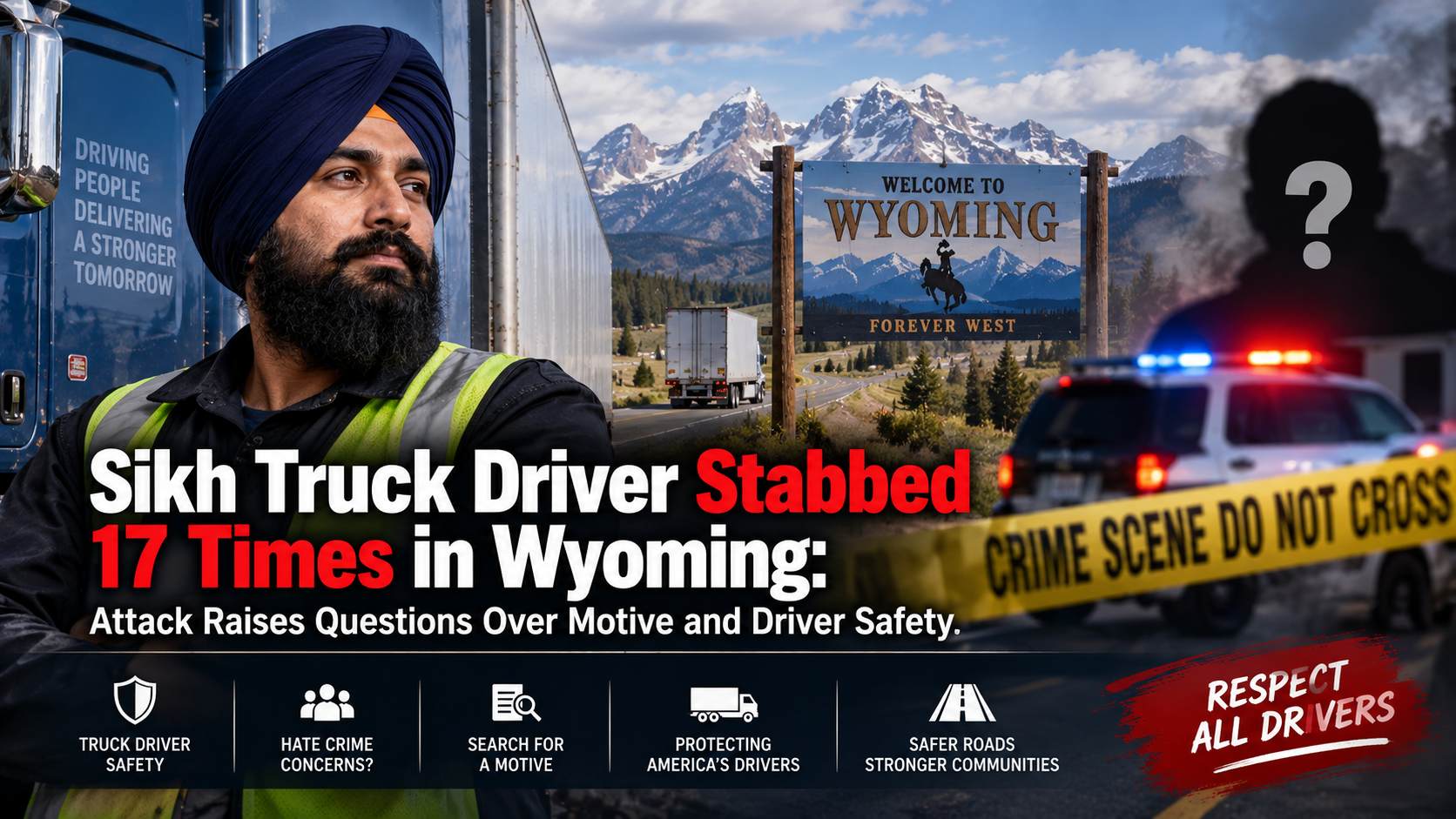
A routine stop on a long American highway journey turned into a terrifying fight for survival for a 28-year-old Sikh truck driver in Wyoming.
The driver, identified publicly only by his surname, Singh, says he was followed into a restroom at the Bitter Creek Rest Area along Interstate 80 before being attacked with a knife. He suffered 17 stab wounds, including injuries to his neck, chest, arms and ribs, and remains hospitalized.
A suspect has been arrested and charged with attempted first-degree murder.
But one crucial question remains unanswered: Why was Singh attacked?
That question has become particularly sensitive because the stabbing occurred only days after a controversial U.S. Department of Homeland Security social-media post featuring an image of a Sikh-looking truck driver identified as “Mr Singh.” However, authorities have not established a connection between the post and the Wyoming attack, and investigators have not announced a motive.
A Highway Stop Suddenly Turns Violent
Singh was driving toward Pennsylvania early Sunday when he stopped at the Bitter Creek rest area in southwestern Wyoming.
He told NPR that he had used the same rest stop before without problems. This time, however, he noticed another man following him as he entered the bathroom.
According to Singh’s account, the man attacked him without warning, initially beating him before pulling out a knife and stabbing him repeatedly.
The assault left Singh seriously wounded.
Despite his injuries, he managed to escape the restroom and make his way outside. He then collapsed and called for help.
A Family at the Rest Stop Helped Save His Life
Singh’s situation might have become even more dangerous had help not arrived quickly.
A Hispanic family at the rest area heard the commotion and rushed toward the injured driver. They helped tend to his wounds and alerted authorities.
The family also provided investigators with information about the suspect’s vehicle.
That information proved valuable as police searched for the attacker.
Singh later described the family as having given him a “second life,” according to NPR’s reporting.
Their intervention illustrates how quickly an ordinary roadside encounter can become a life-or-death emergency—and how important immediate assistance can be when a driver is traveling alone.
Suspect Arrested, But Motive Remains Unknown
Wyoming authorities arrested Andrew Kris Bzdak, 45, after the incident.
According to charging documents cited by NPR, he faces a charge of attempted first-degree murder.
The Wyoming Highway Patrol located the suspect’s tractor-trailer near Rawlins, roughly 113 kilometres from the rest stop, and took him into custody.
But the criminal charge does not answer the most important question surrounding the attack.
Authorities have not publicly established why Singh was targeted.
The stabbing has not been officially classified as a hate crime, and there is currently no confirmed evidence showing that Singh’s Sikh faith, ethnicity or occupation was the reason for the attack.
That distinction is especially important as public discussion around the case intensifies.
Why the “Mr Singh” Post Has Become Part of the Story
The attack occurred only days after a controversial post from the U.S. Department of Homeland Security.
The post featured an AI-generated image of a Sikh-looking man and referred to “Mr Singh” while criticizing immigrant truck drivers. The post was later removed following criticism from Sikh organizations, Indian-American groups and lawmakers.
DHS said the post was referring to Harjinder Singh, an Indian immigrant truck driver who had been accused in connection with a fatal Florida crash.
The department has rejected any suggestion that its post was connected to the Wyoming stabbing, calling attempts to link the two events reckless.
The timing, however, has understandably intensified concern among some Sikh and South Asian Americans.
Sikh Organizations Want the Motive Examined Carefully
Community organizations have urged authorities to investigate all possible explanations for the stabbing, including whether Singh’s identity played any role.
The American Sikh Council has called for investigators to examine whether race or religion could have been a factor while acknowledging that there is currently no evidence establishing such a connection.
That distinction matters.
Calling for investigators to examine a possible motive is not the same as saying that motive has already been established.
The investigation will ultimately have to determine what happened inside the restroom, whether Singh was specifically targeted and what, if anything, motivated the alleged attack.
The Incident Is Affecting Other Truck Drivers
For Sikh truck drivers, the story has a significance beyond one individual case.
Long-haul drivers spend extended periods alone on highways and regularly use truck stops and roadside rest areas, sometimes during overnight hours.
Raman Dhillon of the North American Punjabi Trucking Association told NPR that other drivers had contacted him with concerns about their own safety following the attack.
That reaction highlights the psychological impact of the incident.
If a driver regularly travels hundreds or thousands of miles alone, a roadside rest area is supposed to be a place to stop, eat, refuel and sleep—not somewhere to fear being followed into a restroom.
Singh Is Also Worried About Returning to Work
The attack has left Singh facing more than physical injuries.
He has expressed concern about medical expenses, lost work and what the incident could mean for other Sikh drivers.
He has also said he is worried that something similar could happen again.
For an independent or long-haul driver, time away from the road can quickly translate into financial pressure.
That makes recovery more complicated. The victim is not simply trying to heal; he is also thinking about how to return to a job that requires him to spend long hours traveling through unfamiliar places.
A Wider Debate Over Anti-South Asian Rhetoric
The stabbing has also entered a broader American debate over rhetoric directed at South Asian and immigrant communities.
Stop AAPI Hate reported a significant increase in online slurs targeting South Asians between 2023 and 2025, according to NPR. The organization linked the rise to several political and social controversies, including immigration and the Florida truck crash.
Community advocates argue that public language can affect how minorities feel about their safety.
Government officials, meanwhile, have disputed suggestions that controversial immigration messaging should be held responsible for unrelated criminal acts.
Those are separate questions that should not be collapsed into one conclusion.
A violent attack requires evidence about the attacker and the circumstances of that specific crime.
The Investigation Now Matters More Than the Headlines
The most important unanswered issue is still motive.
Was Singh randomly targeted? Did the suspect know him? Was there a personal dispute? Did the attack involve race or religion? Or was there another explanation?
At this stage, the public record does not provide a definitive answer.
What is known is that Singh was seriously wounded, a suspect has been arrested and charged, and witnesses and investigators have provided information that helped authorities respond quickly.
Everything beyond those established facts needs to be treated carefully.
The Bigger Concern: Can Drivers Feel Safe on the Road?
The Wyoming stabbing has become much larger than a single criminal case because it has touched an already sensitive issue for Sikh and South Asian truck drivers.
Singh’s experience has forced many drivers to think about something they may previously have taken for granted: what happens when you are alone, hundreds of miles from home, and stop at a roadside facility in the middle of the night?
For now, the best path forward is a thorough investigation that establishes what happened and why.
If investigators ultimately find evidence of a hate motive, that finding would have to be addressed directly. If they determine another motive, that should be reported just as clearly.
The timing of the attack and the DHS “Mr Singh” controversy has understandably fueled questions, but timing alone cannot establish causation.
For Singh, the immediate priority is recovery. For investigators, it is determining what led to the attack. And for thousands of truck drivers watching the case, the hope is much simpler: that America’s highways and rest stops remain places where they can do their jobs without fearing who might be waiting around the next corner.









Leave a Reply