

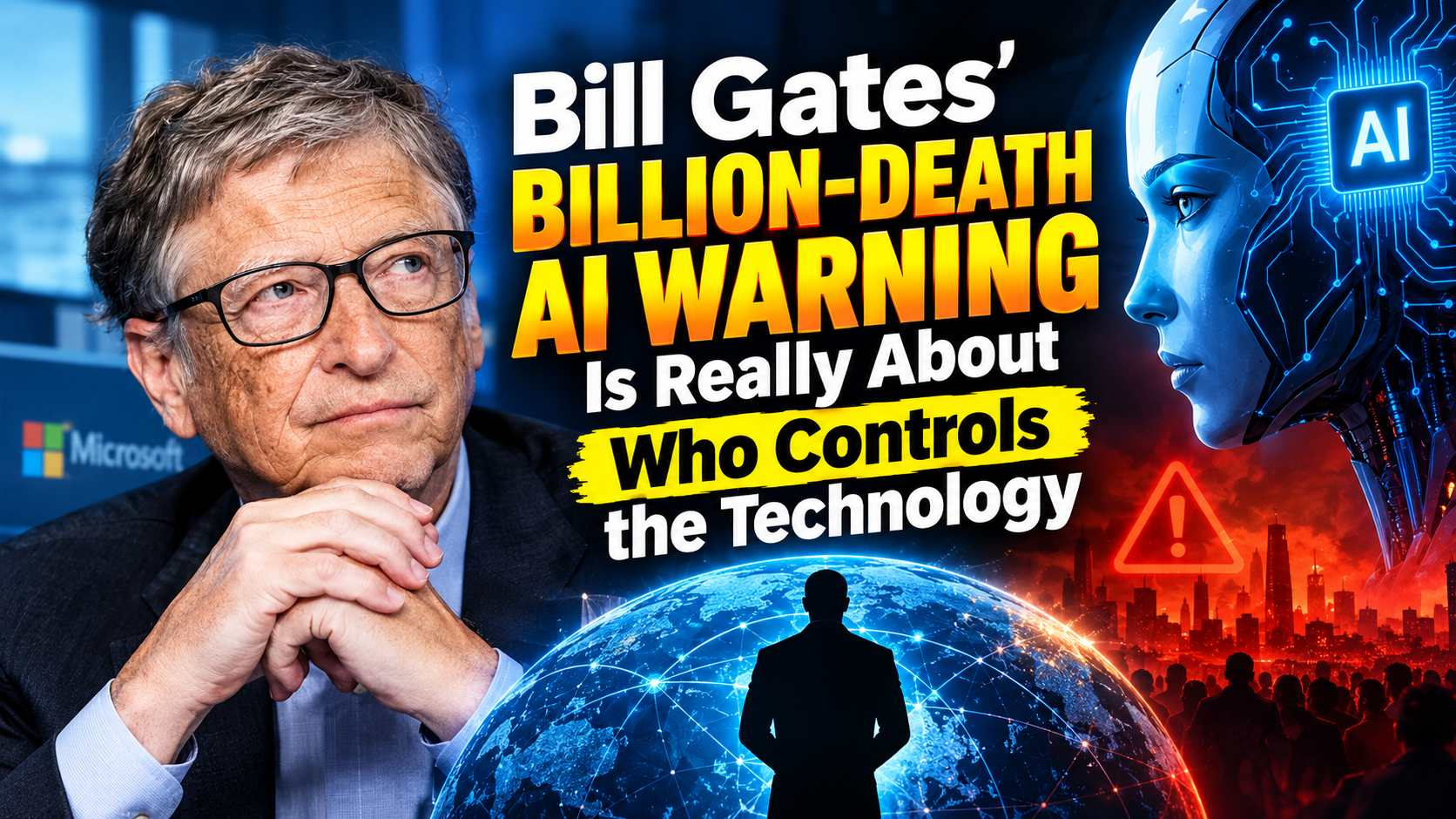
Artificial intelligence has been sold to the world as a tool that can write software, discover medicines, improve education and make businesses more efficient.
But Bill Gates is asking a much darker question: What happens when increasingly powerful AI tools are used by people who deliberately want to cause enormous harm?
The Microsoft co-founder has warned that AI could be powerful enough to help drive events resulting in as many as a billion deaths. His comments have attracted attention because of the scale of the warning, but there is an important distinction: Gates was not predicting that AI will kill one billion people.
He was describing a potential catastrophic scenario if powerful AI systems are combined with malicious human intent.
His proposed response is not to stop AI development.
Instead, Gates wants governments, law enforcement agencies and technology companies to establish mandatory safeguards and monitoring systems before the technology becomes even more capable.
Gates Is Warning About Misuse, Not a Robot Apocalypse
The phrase “a billion deaths” naturally creates images of autonomous machines turning against humanity.
That is not the central argument Gates made.
His concern is that AI could dramatically increase the capabilities of people who already intend to cause harm.
He described AI as powerful enough to “drive events” on a catastrophic scale and argued that the combination of advanced technology and people with malicious intentions could represent a threat unlike previous weapons.
That distinction changes the conversation.
The immediate risk does not necessarily require a machine to develop its own desire to harm humans. AI could potentially be misused to help people conduct cyberattacks, develop dangerous biological capabilities, spread sophisticated misinformation or automate other harmful activities.
In that scenario, the machine is not necessarily the villain.
The problem is the combination of powerful technology, inadequate controls and human intent.
Why Gates Wants Government Involved
Gates argues that voluntary promises from technology companies are not enough.
He has called for lawmakers and law-enforcement authorities to become directly involved in determining what safeguards and monitoring should be required.
That does not necessarily mean shutting down AI laboratories or freezing technological progress.
Gates has specifically argued that regulation could create an additional layer of oversight without dramatically slowing legitimate AI development. He has suggested monitoring whether advanced AI is being used for activities such as cyberattacks or biological terrorism.
Think of it like aviation.
Governments do not ban airplanes because aircraft can crash or be used improperly. Instead, they establish rules covering aircraft design, pilots, maintenance, airports and safety procedures.
Gates appears to be advocating a similar principle for increasingly powerful AI: build the safety system alongside the technology rather than after something goes wrong.
The Warning Comes at a Turning Point for AI
Gates’ comments arrive as the AI industry is entering a more aggressive phase of development.
Companies are competing to build systems capable of reasoning, coding, conducting research and performing increasingly complex tasks with less human supervision.
That progress creates enormous economic opportunities.
It also creates a difficult question.
If AI systems become substantially more capable over the next few years, will governments understand what those systems can do quickly enough to regulate the most dangerous uses?
Gates has argued that governments are currently behind the technology.
In an earlier Reuters interview this month, he said no government was sufficiently prepared for the changes AI could bring to society. At the same time, he emphasized that AI could provide enormous benefits, particularly in poorer countries, if access is expanded responsibly.
That combination is important.
Gates is not presenting AI as purely dangerous.
He is arguing that its benefits and risks are growing at the same time.
The Biological Threat Is One of the Biggest Concerns
One reason AI safety experts are concerned about increasingly capable systems is biology.
AI can already help researchers understand scientific information, analyze large datasets and accelerate parts of the research process.
The same capabilities could potentially be misused.
The Alan Turing Institute recently warned about risks associated with advanced AI, including potential chemical and biological threats. Its report argued that highly capable AI systems could eventually exceed human abilities across many important cognitive tasks and create challenges for maintaining meaningful human control.
That does not mean today’s AI systems can independently create a global biological catastrophe.
It means researchers are increasingly examining whether future systems could lower the barriers to activities that currently require highly specialized knowledge.
That is why safeguards need to be considered before capabilities reach their maximum potential.
Cybersecurity Is Another Major Concern
Cyberattacks provide another example.
AI can already help people write code, analyze information and automate repetitive tasks. Those capabilities can be used for legitimate cybersecurity work, but similar tools could potentially be abused.
A future attacker with access to highly capable AI could potentially automate parts of a cyber campaign at a scale that would be difficult for a small human team to match.
Gates has specifically pointed toward monitoring systems that could identify whether AI is being used in activities such as cyberattacks or bioterrorism.
The challenge is obvious: monitoring must be powerful enough to detect dangerous activity without becoming so intrusive that it undermines legitimate research and privacy.
That balance will be one of the hardest parts of AI regulation.
Gates Is Not Calling for an AI Freeze
This is another point that can easily disappear in sensational headlines.
Gates has not called for AI development to stop completely.
In fact, his recent public statements emphasize both regulation and the potential benefits of AI.
The Gates Foundation announced a $1 billion commitment toward AI-related initiatives focused on areas including healthcare, education and agriculture in developing countries.
That creates an interesting contrast.
The same person warning that AI could contribute to catastrophic harm is also investing heavily in using the technology to improve lives.
The underlying message is not “AI is bad.”
It is closer to “AI is too powerful to develop without safeguards.”
The Industry Is Divided Over How Much Regulation Is Needed
Gates is not alone in raising concerns about advanced AI.
Anthropic CEO Dario Amodei has also warned about the possibility of severe risks from increasingly capable AI and has called for stronger safety frameworks. He told the United Nations Security Council that poorly managed AI could become a risk to humanity.
But there is no universal agreement about how serious the risks are, how quickly they might emerge or what regulations should look like.
Some technology leaders emphasize rapid development because they believe maintaining technological leadership is economically and strategically important.
That disagreement is especially significant in the United States and China, where AI has increasingly become part of the competition over technology and national security.
The policy challenge is therefore not simply whether AI should be regulated.
It is how to regulate it without preventing beneficial innovation or pushing development into less transparent environments.
Trump and Gates See the Issue Differently
The debate has also reached the White House.
President Donald Trump has expressed skepticism toward some of the more extreme AI warnings and has argued against imposing regulations that could slow the American AI industry while the United States competes with China.
Gates has taken a different position.
He has said lawmakers need to establish mandatory safeguards while arguing that such measures would not necessarily impose a dramatic slowdown on the industry.
The disagreement illustrates the central policy dilemma.
Governments want technological leadership.
Companies want room to innovate.
Safety researchers want stronger controls.
And the public wants the benefits of AI without becoming the test case for its worst failures.
Regulation Will Have to Become More Specific
Simply passing an “AI safety law” will not solve the problem.
Different AI applications create different risks.
A system helping a student learn mathematics does not pose the same potential danger as an advanced model being used for cybersecurity research or biological analysis.
That means future regulation may need to focus particularly on the most powerful systems and the highest-risk applications.
Independent testing could become important.
So could security evaluations, incident reporting, access controls and restrictions on certain dangerous capabilities.
The goal would not necessarily be to control every AI-generated image or chatbot conversation.
It would be to establish stronger protections around the systems capable of causing the greatest harm.
The Bigger Question Is Who Gets the Power
This is ultimately the most important part of Gates’ warning.
Technology has always amplified human capabilities.
A printing press amplified communication.
Industrial machinery amplified physical work.
Computers amplified calculation.
AI could amplify reasoning, research and decision-making.
That creates extraordinary opportunities.
But amplification works in both directions.
A person trying to solve a problem can become more effective with AI. A person trying to cause harm could potentially become more effective too.
That is why the question of AI safety cannot be separated from the question of access and accountability.
Who can use the most powerful systems?
What are they allowed to do?
Who monitors them?
What happens when a system is misused?
And who is responsible when something goes wrong?
The Billion-Death Figure Should Be Read as a Warning, Not a Forecast
Gates’ most dramatic phrase has understandably become the headline.
But treating it as a prediction would miss the actual argument.
He did not say one billion people are expected to die because of AI.
He warned that AI could potentially help create events with catastrophic casualties if powerful systems are combined with malicious intent and inadequate safeguards.
That is a warning about risk, not a forecast.
And it is part of a much larger debate that is only beginning.
The Race Is No Longer Just About Building Smarter AI
The next stage of the AI competition may therefore involve something beyond larger models and faster computers.
It may be a race to build better safety systems at the same time as more powerful AI systems.
Gates’ argument is that governments should not wait until an AI-related disaster forces them to act.
His position is also not that society should abandon the technology.
AI could improve healthcare, education, agriculture and scientific research on a massive scale. His own foundation is investing in those applications.
The real challenge is making sure that the systems capable of producing extraordinary benefits do not become equally extraordinary tools for destruction.
That makes Gates’ “billion deaths” warning less about predicting the future and more about deciding how much safety society is willing to build before that future arrives.







Leave a Reply