

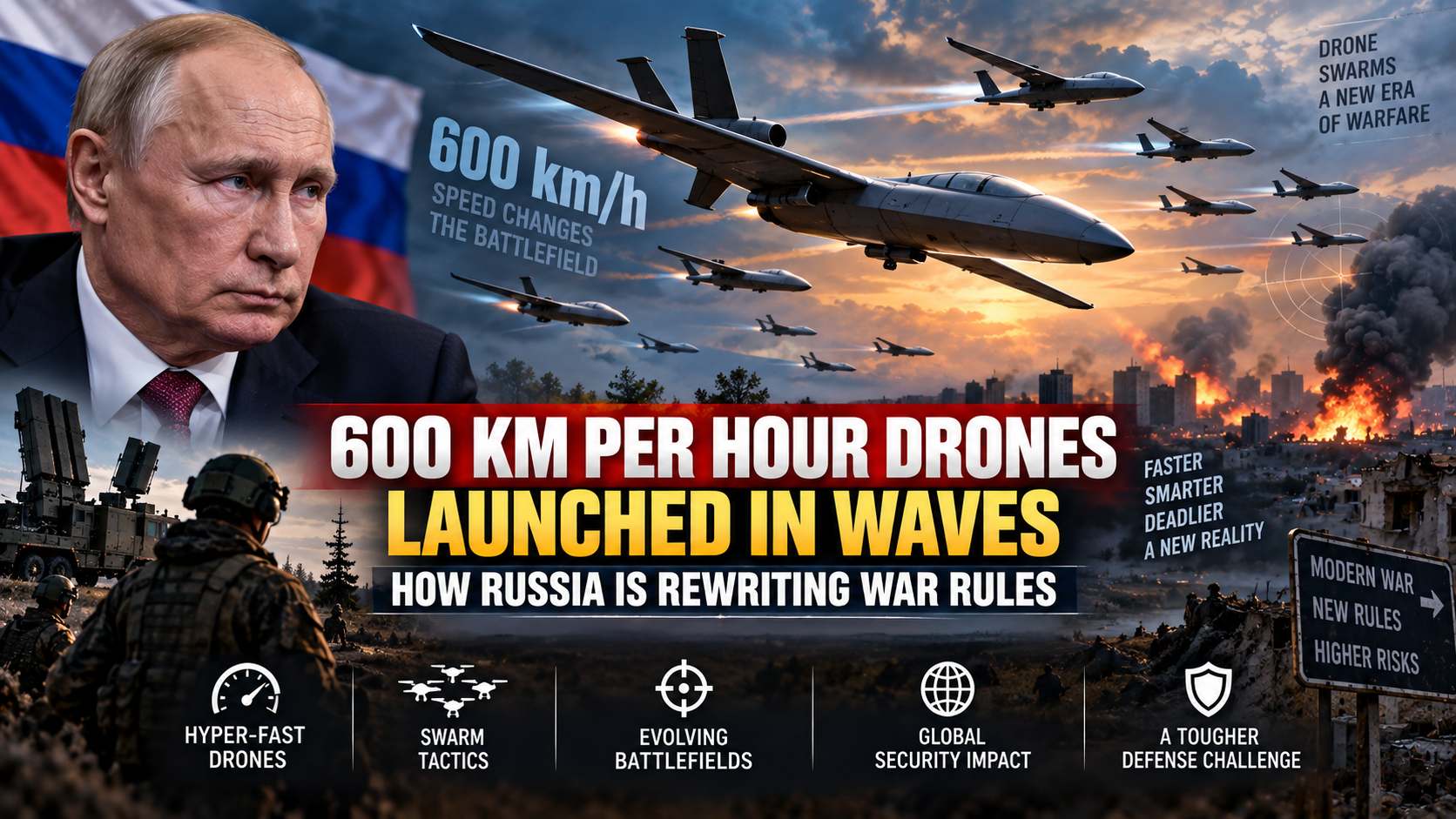
A drone traveling at hundreds of kilometers per hour may sound like a technological upgrade. In Ukraine, however, Russia’s new generation of jet-powered attack drones represents something much bigger.
The battlefield is increasingly becoming a race between how cheaply an attacker can put a weapon into the sky and how much a defender must spend to stop it.
The Geran-5 has become a symbol of that shift. The drone is reported to have a maximum speed of around 600 kilometers per hour and a range approaching 1,000 kilometers, although exact specifications can vary by configuration. Unlike the slower, propeller-driven Shahed-type drones that dominated earlier Russian attacks, the newer jet-powered variants give Ukrainian defenders far less time to detect, identify and engage them.
But speed alone does not explain why these weapons matter.
Russia is combining faster drones with increasingly large attack waves. That combination is forcing Ukraine to reconsider how its entire air-defense system is organized.
The Drone Has Become Part of a Bigger Weapon System
Russia’s Geran family is derived from the Shahed-type attack drones that Moscow began using extensively during the war.
Earlier versions were relatively slow and could often be targeted by mobile air-defense teams using machine guns, autocannons, electronic warfare and inexpensive interceptor drones.
Ukraine adapted.
That adaptation helped produce high interception rates against some earlier drone attacks. But Russia responded by changing the problem rather than abandoning the weapon.
Jet propulsion changed the equation.
Recent reporting indicates that the newer Geran variants can travel substantially faster than the earlier systems, with the Geran-5 estimated at up to about 600 km/h. Some versions can also be controlled or have their routes altered during flight, making them less predictable than simple weapons programmed to fly toward fixed coordinates.
The result is a shrinking window for Ukrainian defenders.
And in air warfare, seconds matter.
Why 600 km/h Changes the Interception Problem
Imagine trying to stop a speeding car while you are standing farther down the road.
If the car is moving slowly, you have time to see it, decide what to do and move into position.
Now imagine the same car approaching several times faster.
The problem is no longer simply whether you have a weapon capable of stopping it. You also need sensors, communications and an interceptor that can react quickly enough.
That is the challenge facing Ukraine.
Reuters reported this month that Ukrainian efforts to develop high-speed interceptor drones have encountered difficulties, with some systems struggling to remain controllable at very high speeds.
This illustrates an uncomfortable reality of modern air defense: the fastest weapon does not necessarily need to be the most sophisticated weapon if it forces the defender to react faster than its system allows.
Russia’s Real Advantage May Be Volume
The Geran-5 would be significant even as a standalone weapon.
But Russia is not relying on individual drones.
It is relying on numbers.
NDTV reported that Russia launched around 450 jet-powered drones in June and approximately 2,850 in August, while Reuters has separately reported a rapid increase in Russia’s use and production of jet-powered drones. The exact production and launch figures are difficult to independently verify and should therefore be treated as reported estimates rather than precise battlefield totals.
That distinction matters because an air-defense system can have an impressive percentage interception rate and still face an overwhelming problem.
If hundreds of weapons arrive in a coordinated wave, even a high interception percentage can leave enough surviving weapons to hit important targets.
The attacker therefore does not necessarily need every drone to succeed.
The attacker needs enough of them to get through.
The Cost Equation Is Becoming the Battlefield
This may be the most important lesson from Russia’s drone campaign.
A country can possess some of the world’s most sophisticated air-defense systems and still face a serious problem if it is forced to use expensive interceptors against large numbers of comparatively cheaper attack drones.
That creates what military analysts often describe as an unfavorable cost exchange.
Russia can launch another wave.
Ukraine has to decide what to shoot down, what to jam, what to intercept with cheaper systems and what it can afford to leave for higher-end defenses.
This makes air defense partly an economic problem.
The question becomes less about whether Ukraine can destroy a particular drone and more about whether it can continue destroying thousands of drones month after month without exhausting missiles, interceptor drones, ammunition, crews and spare parts.
Ukraine’s Old Counter-Drone Model Is Being Tested
Ukraine’s earlier response to Shahed-type attacks relied on layers of defenses.
Mobile firing teams could engage slower drones. Electronic warfare could disrupt navigation. Fighter aircraft and surface-to-air missile systems could handle more difficult targets.
The arrival of faster drones complicates that structure.
A weapon traveling at roughly 600 km/h cannot be treated like a slow propeller-driven aircraft. The detection-to-interception timeline becomes much shorter.
That means Ukraine needs faster interceptors, better sensors and increasingly automated systems capable of making decisions in very short periods.
Reuters reported that Ukraine is exploring new interceptor concepts and other ways of dealing with the growing jet-powered drone threat.
The race has therefore moved beyond drones.
It is now a race involving radars, software, electronic warfare, artificial intelligence, manufacturing capacity and ammunition production.
Russia Is Also Learning From Every Attack
The drone campaign is not static.
Every large attack gives Russia information about Ukrainian air-defense responses.
Where were radars active? Which routes produced interceptions? Which altitudes worked? Which approaches were vulnerable?
Attack planners can then adjust subsequent waves.
That means a drone attack can serve two purposes at once: strike a target and probe the defensive network.
Large formations also allow attackers to vary routes, altitudes and timing.
The defender has to respond to all of those possibilities.
This Does Not Make Missiles Obsolete
It would be easy to conclude that fast drones are replacing cruise and ballistic missiles.
That would go too far.
Missiles remain faster, more powerful and better suited to certain heavily defended or time-sensitive targets.
Instead, the battlefield appears to be developing a division of labor.
Large numbers of drones can create pressure on air defenses, while more expensive missiles can be reserved for targets where their capabilities justify their cost.
That means drones may not replace missiles.
They may make missiles more selective weapons.
The Battle Is Moving Into Factories
There is another part of this story that receives less attention.
A modern air war is increasingly determined by manufacturing.
If Russia can produce thousands of attack drones while Ukraine and its allies struggle to manufacture enough affordable interceptors, the technological balance can change even without a dramatic breakthrough in individual weapons.
That is why Ukraine’s response cannot simply be a search for one perfect interceptor.
It needs systems that can be produced in large quantities.
A $1 million solution that can be manufactured only a few times a month may be less useful against an enemy capable of launching thousands of relatively inexpensive weapons.
The future of air defense may therefore look increasingly like an industrial contest.
The Rear Area Is No Longer a Safe Area
For decades, military planners separated the battlefield from the rear.
Factories, fuel depots, power infrastructure and logistics centers could operate hundreds of kilometers from the front while relying on distance for protection.
Long-range drones are weakening that assumption.
A weapon capable of traveling hundreds of kilometers can turn distance into only a temporary shield.
That has implications far beyond Ukraine.
Military planners around the world now have to consider what happens when inexpensive unmanned weapons can threaten infrastructure deep behind the front line.
Air bases, fuel facilities, ports, warehouses and power networks may all require stronger protection.
What Russia Is Really Rewriting
The most important development may not be that Russia has built a drone capable of reaching 600 km/h.
Military technology has always become faster.
The bigger change is the combination of speed, range, autonomy, mass production and relatively low-cost manufacturing.
Put those ingredients together and the traditional economics of air warfare begin to change.
A defender can no longer assume that advanced technology alone will guarantee protection. It also needs enough technology, enough ammunition, enough trained personnel and enough industrial capacity to sustain the defense.
That is the lesson emerging from Ukraine.
The next generation of air warfare may not be decided by the country with the most sophisticated missile.
It could be decided by the country capable of producing, deploying and defending against thousands of weapons at the same time.
Russia’s Geran-5 is therefore more than another drone entering the war. It is part of a broader transformation in which quantity and economics are becoming just as important as speed and precision.
And as Ukraine races to build a cheaper answer, other militaries are watching closely. What happens over Ukrainian cities today could influence how countries around the world design their air defenses tomorrow.











Leave a Reply