

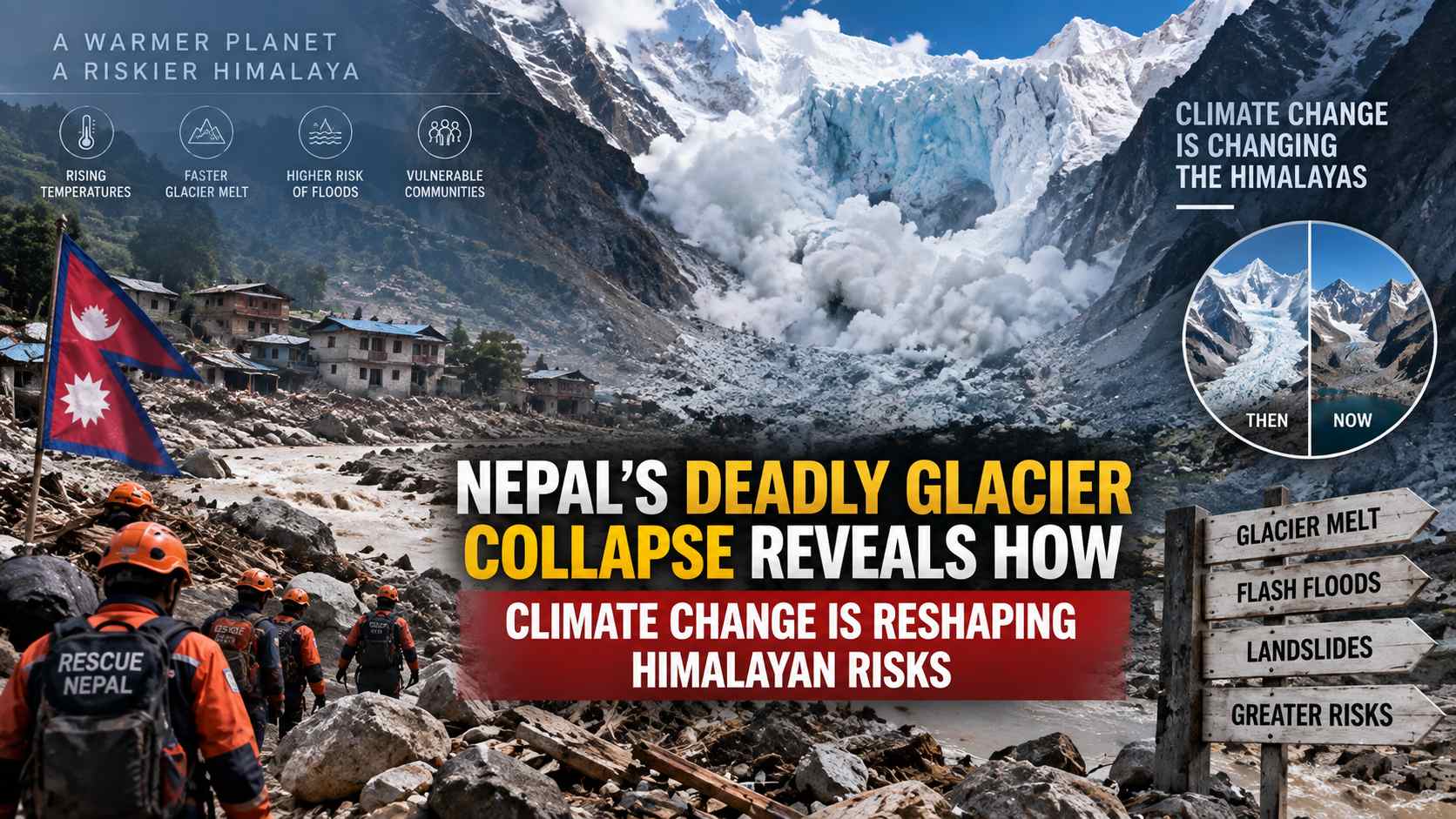
The devastating disaster that swept through parts of Nepal in August was not caused by a single event.
Instead, scientists say it appears to have been the result of several forces coming together on an already vulnerable Himalayan mountainside: a weakened rock structure, shrinking glaciers, thawing permafrost, unusually warm conditions and large amounts of meltwater.
A new analysis by World Weather Attribution found that human-caused climate change likely helped destabilize the slope that collapsed on August 26, triggering a massive cascade of rock, ice, water and debris that raced downstream through communities in Nepal and neighboring areas.
More than 1,300 people had been confirmed dead by mid-September, with thousands more still missing, according to the analysis. The disaster caused widespread destruction along the Trishuli River corridor.
But scientists have emphasized an important point: climate change was not the sole cause, and the study did not establish that the collapse would not have happened without global warming.
The deeper story is about how warming is changing the physical stability of the world’s highest mountains.
The Disaster Began High Above the Flooded Valleys
The catastrophe started near Langtang Lirung mountain, close to the Nepal-China border.
On August 26, a huge section of rock and glacier ice collapsed from the mountainside. World Weather Attribution estimates that roughly 2 square kilometers of rock wall and glacier ice were involved. The falling material then transformed into a rapidly moving debris flow and eventually a powerful flood.
The initial seismic signal was reportedly strong enough to resemble an earthquake.
But later analysis indicated that the shaking was associated with the enormous rock-and-ice collapse itself rather than a new earthquake triggering the disaster.
That distinction changed the scientific understanding of what happened.
The mountain did not simply receive a sudden blow from outside. Its own structure had been changing for years.
Climate Change Did Not Create the Mountain’s Weakness Overnight
One of the most important findings from the new analysis is that climate change works gradually.
Glaciers in the region have been thinning by roughly half a meter each year since around 2000, according to the research. That loss of ice changes the pressure and stresses acting on surrounding rock.
At the same time, permafrost—the ground that remains frozen for long periods—has been thawing.
That matters because frozen material can help bind fractured mountain rock together. When temperatures rise and the ice inside cracks disappears, some slopes can become less stable.
It is a little like removing the frozen glue from a stack of rocks. The rocks may remain in place for years, but the structure becomes progressively more vulnerable.
The Freezing Line Is Moving Higher
Researchers identified another major change in the Himalayas.
Warming has pushed the elevation at which ground can remain consistently frozen upward by approximately 100 meters every decade. That means areas at higher elevations that once remained frozen throughout the year are increasingly experiencing temperatures above freezing.
The consequence is not simply less ice.
It can also mean more cracks, more meltwater and weaker rock.
At elevations around 5,000 meters, scientists have observed areas where rock and ground that previously stayed frozen year-round no longer do so.
For a mountain region filled with steep slopes and fractured rock, that change can have serious consequences.
The 2015 Earthquake May Have Left a Vulnerable Mountain Behind
Climate change is only part of the explanation.
In 2015, Nepal experienced a devastating magnitude-7.8 earthquake that caused widespread destruction and triggered landslides and avalanches across the Himalayas.
Scientists believe that earthquake may have weakened the underlying rock around Langtang Lirung.
The exact contribution of the earthquake remains uncertain, but researchers say it could have left the mountainside structurally vulnerable years before the 2026 collapse.
That creates an important distinction.
The earthquake may have helped create the weakness. Long-term warming may have progressively added stress to it.
The final collapse could therefore be understood as a chain of interacting factors rather than a single trigger.
An Exceptionally Warm Period Added More Pressure
The weeks leading up to the collapse were unusually warm.
According to the World Weather Attribution analysis, temperatures across the Himalayan region in August were about 5 degrees Celsius above normal, with researchers estimating that around 1.5 degrees of that anomaly was attributable to human-caused climate change.
Researchers also pointed to unusually heavy snowfall in October and November of the previous year.
When temperatures subsequently rose, that additional snow contributed to the amount of water available for melting.
The result was a dangerous combination: more ice and snow available to melt, unusually high temperatures and a mountain slope already vulnerable because of geological and long-term environmental changes.
From Rockfall to Flood in a Matter of Minutes
What happened next demonstrates why Himalayan disasters can become so destructive so quickly.
The collapsing rock and ice plunged roughly 1,400 meters from the mountainside toward the valley floor, according to the World Weather Attribution analysis. The enormous mass generated tremendous energy as it fell.
Once the avalanche reached lower elevations, it interacted with additional ice, water and debris.
The resulting flow became increasingly water-dominated as it moved downstream.
Instead of remaining a localized landslide, the event effectively transformed into a massive flood capable of carrying boulders, mud and enormous quantities of sediment into populated areas.
That cascading behavior is one of the most important lessons from the disaster.
Why Himalayan Communities Face a Growing Risk
People living in Himalayan valleys face a difficult geographical reality.
Communities often have little choice but to build settlements, roads, bridges and other infrastructure close to rivers and steep mountain slopes.
Those locations provide access to water, transportation corridors and agricultural land.
But they can also put communities directly in the path of landslides, glacial floods and debris flows.
As the climate warms, scientists are increasingly concerned that hazards once associated mainly with ice and snow could become more complicated.
A melting glacier does not only mean less ice.
It can change the stability of the mountains surrounding it.
This Was Not Simply an “Extreme Weather” Disaster
Another important finding is that the event does not fit neatly into the usual category of an extreme rainfall disaster.
The World Weather Attribution researchers described the event as a cascading geological and climate-related hazard rather than simply an extreme weather event.
That matters because traditional disaster planning may focus heavily on rainfall forecasts.
But what happens when the danger begins thousands of meters above a community?
A slope can become unstable because of long-term warming, glacier retreat and permafrost thaw. Then a sudden collapse can create its own flood.
By the time water reaches a valley, the original trigger may be almost impossible for residents to recognize.
Scientists Are Not Saying Every Himalayan Collapse Is Caused by Climate Change
The new research should also be interpreted carefully.
The scientists did not calculate that climate change directly caused this specific collapse with certainty. They concluded that warming created or intensified conditions that made the collapse more likely.
That difference is scientifically important.
Mountains are complicated geological systems. Rock composition, fractures, previous earthquakes, snow accumulation, rainfall, meltwater and temperature can all interact.
Climate change can alter some of those factors without being the only reason a particular slope fails.
In Nepal’s case, the evidence points toward a combination of geological vulnerability and climate-related destabilization.
The Warning Extends Far Beyond Nepal
The implications are not limited to one Himalayan valley.
Similar processes can occur in other high mountain regions where glaciers are retreating and permafrost is thawing.
The Andes, Alps and other mountain systems are also experiencing changes in frozen ground and glacier conditions.
That means the Nepal disaster offers scientists and governments an opportunity to rethink how mountain hazards are monitored.
Satellites, ground sensors, glacier measurements and early-warning systems could become increasingly important as mountain conditions change.
The Next Challenge Is Detecting Danger Before the Collapse
One of the hardest problems is knowing when a mountain has crossed from “unstable” to “about to fail.”
A glacier can retreat slowly for decades without producing a catastrophic event.
Permafrost can thaw gradually.
Rock fractures can widen almost invisibly.
Then, suddenly, a massive section of the mountain can collapse.
That makes monitoring especially important in areas where people live downstream.
Better mapping of unstable slopes, more detailed glacier observations and improved warning systems could give communities additional time to evacuate when conditions become dangerous.
Nepal’s Disaster Is a Glimpse of a Changing Mountain Future
The August catastrophe has left Nepal facing an enormous humanitarian and reconstruction challenge.
But its scientific significance may last much longer.
The disaster shows that climate change does not only affect temperatures, rainfall and sea levels. In high mountain environments, warming can also change the physical structures that hold mountains together.
The Langtang Lirung collapse appears to have emerged from a complicated chain: an already vulnerable geological structure, possible damage from the 2015 earthquake, decades of glacier thinning, thawing permafrost, unusual snowfall and exceptionally warm conditions.
No single factor tells the entire story.
But the warning from scientists is increasingly clear: as the Himalayas warm, some hazards may become less predictable and more interconnected.
The real lesson from Nepal may therefore not be simply that climate change caused a deadly flood.
It is that a warming mountain can quietly change for years before a disaster becomes visible—and when the collapse finally comes, the consequences can travel far beyond the ice and rock that first gave way.











Leave a Reply