

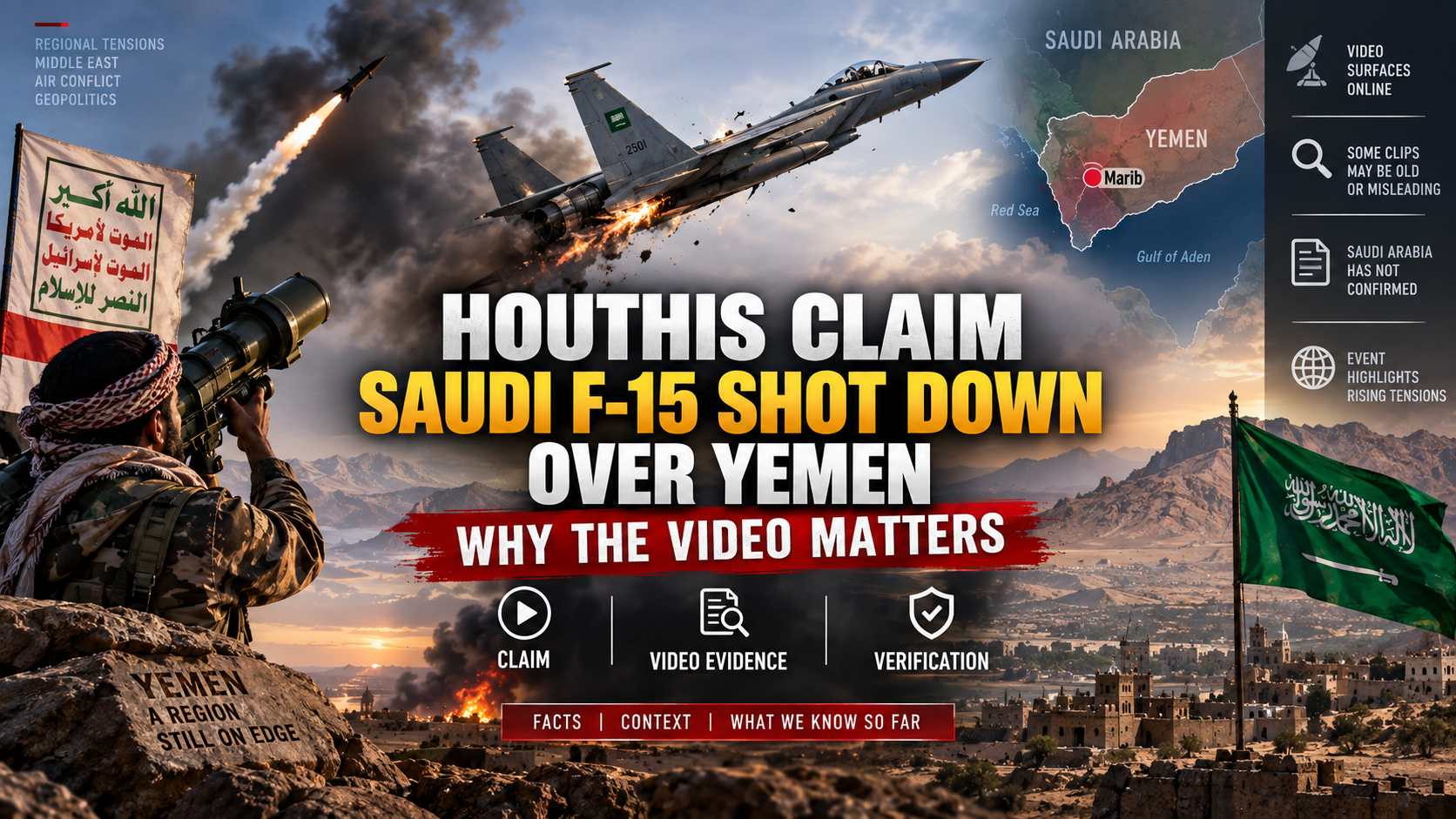
A new claim from Yemen’s Houthi movement has put Saudi Arabia’s air campaign under fresh scrutiny.
The Houthis say they shot down a Saudi F-15 fighter over Marib province using a locally manufactured missile and have released video footage that they say shows the aircraft being hit and its wreckage on the ground.
The claim comes as fighting between the Houthis and Saudi-backed forces intensifies across Yemen and Saudi Arabia faces growing threats to its military positions, oil infrastructure and territory.
But there is an important caveat: Saudi Arabia had not publicly confirmed the loss of the F-15 in the reporting available, and the video has not independently established exactly when and where the aircraft was brought down.
That leaves two separate questions. Did a Saudi fighter actually go down? And if it did, what does that tell us about the Houthis’ evolving air-defense capabilities?
What Are the Houthis Claiming?
Houthi military spokesman Yahya Saree said the group had successfully intercepted a Saudi F-15 while it was conducting operations over Marib.
He claimed the aircraft was brought down with a locally manufactured missile.
The Houthis also said their forces later engaged additional Saudi F-15 and Eurofighter Typhoon aircraft that were searching for the wreckage and forced them to withdraw. Those additional claims have also not been independently verified.
The announcement was accompanied by footage showing lights in the night sky, burning wreckage and debris scattered across a desert area.
One piece appears to be part of an aircraft wing carrying Saudi markings. Armed Houthi fighters can also be seen standing around the wreckage. Reuters’ video description, however, specifically notes that the location and timing could not be independently verified.
That distinction matters when assessing battlefield footage released by an armed group.
The Video Adds Evidence, But Not the Full Story
The images are more substantial than a simple social-media claim.
The footage contains apparent aircraft debris and a Saudi marking, while specialist defense analysts have examined the material. Janes reported that the imagery was consistent with the loss of a Saudi Advanced Eagle variant of the F-15.
But identifying wreckage is not the same as independently establishing the circumstances of the loss.
The footage does not by itself prove which missile was used, the precise location of the engagement or the exact sequence leading to the crash.
That is why the most accurate description remains a Houthi claim of a Saudi F-15 shoot-down supported by footage that appears to show wreckage, rather than an independently confirmed combat loss.
Why an F-15 Loss Would Matter
The F-15 has long been one of the most important aircraft in Saudi Arabia’s military arsenal.
The Royal Saudi Air Force operates advanced versions of the American-designed fighter, which has been central to Saudi air operations in Yemen.
For years, Saudi aircraft have enjoyed a major technological advantage over Houthi forces operating on the ground.
If the Houthi claim is confirmed, the incident would therefore carry significance beyond the loss of one aircraft.
It would demonstrate that Saudi aircraft operating over contested areas face a potentially serious air-defense threat.
Janes described the reported incident as the first combat loss of an Advanced Eagle variant.
The question then becomes whether this was an isolated success or evidence of a broader improvement in Houthi air defenses.
The Missile Claim Is the Bigger Question
The Houthis’ assertion that they used a locally manufactured missile is likely to attract as much attention as the aircraft itself.
The group has spent years developing and modifying missiles and drones, often amid international accusations that Iran has provided varying levels of support and technology.
But claiming that a weapon is locally manufactured does not automatically establish how much of its technology was designed or produced inside Yemen.
Nor does one successful engagement demonstrate that the Houthis have suddenly achieved air superiority.
Modern air combat is much more complicated than simply matching one missile against one fighter.
Aircraft tactics, electronic warfare, radar coverage, pilot awareness, altitude, weapons range and intelligence all influence the outcome.
If the F-15 was indeed destroyed, investigators and military analysts will want to understand which combination of those factors allowed the engagement to succeed.
Marib Has Become an Important Battlefield
The reported shoot-down also needs to be viewed within the broader battle for Yemen.
Marib is strategically important because of its location and its energy resources. It has remained a major point of contention between the Houthis and forces aligned with Yemen’s internationally recognized government.
The renewed fighting has expanded beyond isolated exchanges.
Recent reporting indicates that the Houthis have made territorial gains while Saudi Arabia has increased military activity against them.
That makes control of the air especially important.
For Saudi forces, aircraft provide the ability to strike targets deep inside Yemen. For the Houthis, threatening those aircraft could complicate Saudi military operations and raise the cost of maintaining an air campaign.
The Timing Is Also Significant
The alleged F-15 shoot-down came during a particularly tense period between Riyadh and the Houthis.
Saudi Arabia recently said its air defenses intercepted a Houthi drone south of Mecca before it entered the city’s restricted airspace.
The Houthis denied targeting the holy sites and said their operations were aimed at Saudi military and oil-related targets.
The dispute has raised the political stakes considerably.
Any confirmed attack affecting the security of Mecca would have consequences far beyond the battlefield, while Saudi Arabia has described the security of the Two Holy Mosques as a red line.
Against that backdrop, a claimed Saudi fighter loss adds another layer to an already rapidly escalating confrontation.
Saudi Air Power Faces a New Challenge
Saudi Arabia possesses sophisticated fighter aircraft, advanced weapons and a substantial defense infrastructure.
But air power is never simply about owning better aircraft.
A fighter operating over an area where an adversary possesses concealed air-defense systems is still exposed to risk.
The Houthis have spent years developing a mix of drones, missiles and air-defense weapons. Their ability to threaten Saudi territory has already forced Riyadh to devote significant resources to air defense.
The alleged F-15 loss raises a different question: can Saudi aircraft continue operating over contested Yemeni territory at the same level of freedom?
That may ultimately be more important than the individual aircraft loss.
The Risk Extends Beyond the Battlefield
The consequences could also reach the energy and shipping markets.
The Houthis have increasingly targeted Saudi interests as fighting has intensified, while the Bab el-Mandeb waterway has become another major pressure point.
The strategic importance of the route has increased because disruptions around the Strait of Hormuz have already placed additional pressure on regional energy flows.
Any prolonged conflict affecting both the Gulf and Bab el-Mandeb creates a complicated problem for oil producers, shipping companies and governments that depend on stable maritime trade.
A military aircraft being shot down may therefore become part of a much larger regional security story.
One Jet Does Not Prove a Change in the Balance of Power
It would be premature to conclude that the Houthis have overcome Saudi Arabia’s broader air-power advantage.
A single reported shoot-down, even if eventually confirmed, cannot establish a complete transformation of the military balance.
At the same time, dismissing the incident would also be difficult if independent evidence eventually confirms the Houthi account.
The significance lies in what comes next.
Will Saudi Arabia acknowledge the loss? Will investigators identify the weapon involved? Will further attacks demonstrate that the Houthis have developed a more effective air-defense network?
Those answers will determine whether this was an isolated battlefield success or part of a wider change.
The Real Story Is the Growing Cost of Operating Over Yemen
For now, the safest conclusion is that the Houthis have made a significant claim and released imagery that appears to show Saudi aircraft wreckage, but important details remain unconfirmed.
If the F-15 loss is independently confirmed, the event could mark an important moment in the renewed Saudi-Houthi conflict.
The bigger issue, however, is not simply whether one fighter was destroyed.
It is whether the Houthis are making the skies over Yemen increasingly dangerous for some of the region’s most advanced combat aircraft.
That is a very different question—and one that could shape how Saudi Arabia conducts its next phase of military operations.
In a conflict where drones, missiles, oil facilities and shipping routes are already being used as pressure points, control of the air could become the next major contest.









Leave a Reply