

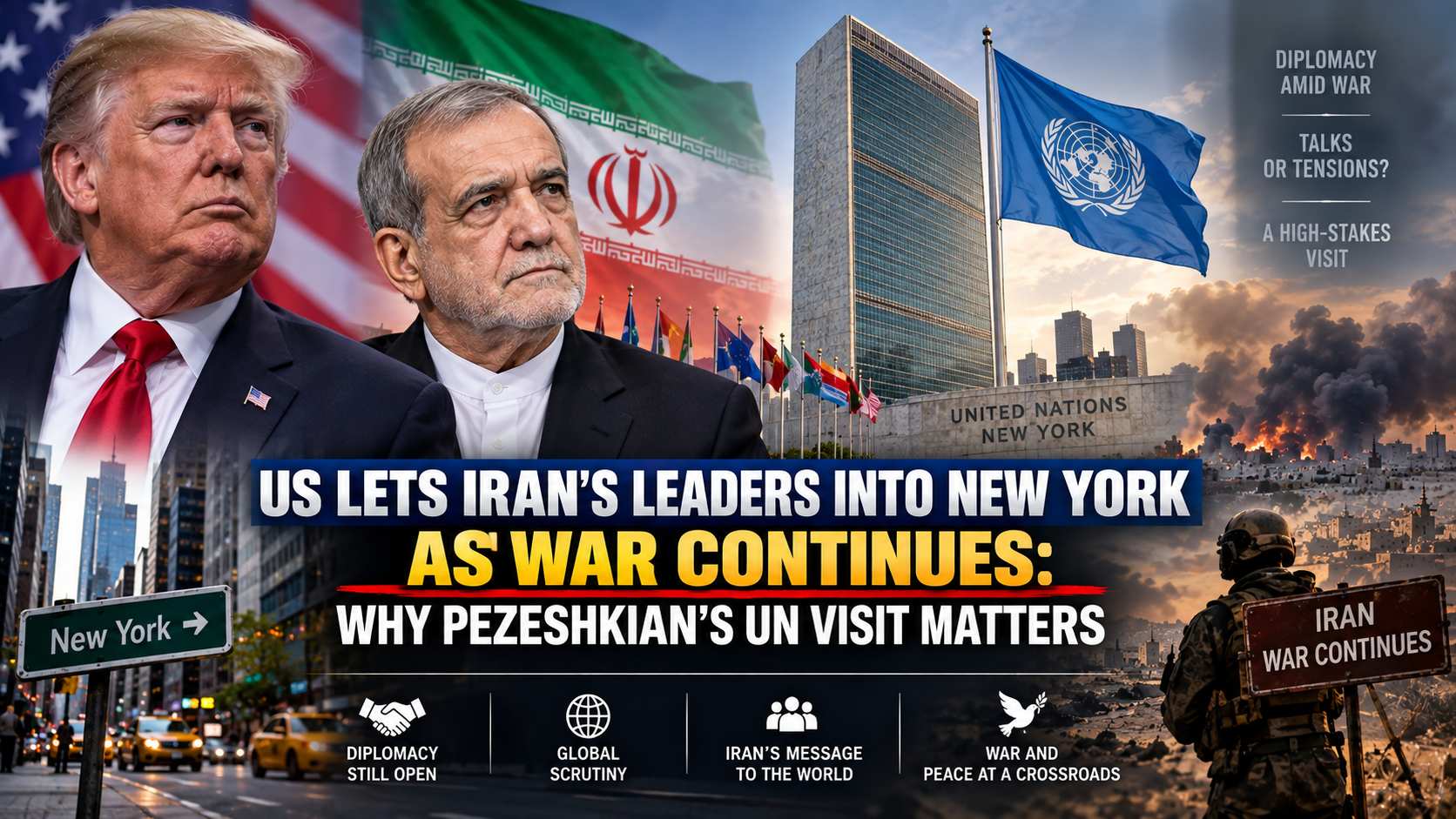
Washington and Tehran remain locked in a war that has stretched into its seventh month. Yet next week, one of Iran’s most senior leaders is expected to walk into the United Nations headquarters in New York.
The Trump administration has approved visas for Iranian President Masoud Pezeshkian, Foreign Minister Abbas Araghchi and other members of Iran’s core delegation to attend the United Nations General Assembly’s high-level meetings. The decision comes despite continuing hostilities, U.S. sanctions against Iran and the absence of a clear agreement to end the conflict.
Rather than simply being a visa decision, the move creates an unusual diplomatic opening. For several days, officials from countries that are fighting each other will be operating in the same city, surrounded by diplomats and international leaders.
Why Is Washington Allowing Iranian Leaders Into the US?
The U.S. State Department said the decision was consistent with Washington’s obligations as the host country of the United Nations.
Under the 1947 U.N. headquarters agreement, the United States has responsibilities to facilitate access to the U.N. for foreign diplomats. Washington nevertheless maintains that it can impose restrictions or deny entry in certain circumstances involving security, terrorism and foreign-policy concerns.
This time, the administration chose to allow Iran’s core delegation to attend.
The State Department said the Iranian delegation would be smaller than last year and would remain subject to travel restrictions. Members will also face restrictions on purchasing luxury and certain other goods while in the United States.
So the decision is not a return to normal diplomatic relations. It is a limited opening created around the United Nations gathering.
Pezeshkian’s Presence Could Put Iran’s War Message on the World Stage
President Pezeshkian’s expected appearance gives Tehran an opportunity to present its position directly to an international audience.
The General Assembly is one of the few places where the Iranian president can address dozens of world leaders and delegations at the same time. His speech is likely to attract particular attention because the U.S.-Iran conflict remains unresolved.
The United States and Israel began military action against Iran on February 28, according to current reporting, while Iran subsequently launched attacks against Israel and Gulf states hosting U.S. military facilities. The conflict has also affected regional shipping and energy markets.
That means Pezeshkian’s appearance will carry significance far beyond the usual diplomatic calendar.
A War Zone and a Diplomatic Hall in the Same Week
The most striking aspect of the decision is the contrast.
On one side, Washington and Tehran remain military adversaries. On the other, their senior officials are being allowed to meet indirectly in the same diplomatic environment.
It is a little like two teams still playing a fiercely contested game being required to sit at the same table before the final whistle. The presence of both sides does not mean the dispute is resolved, but it creates an opportunity for communication.
Reuters reported that the United States and Iran have continued intermittent efforts aimed at ending the conflict, although major issues remain unresolved. These include the future of Iran’s nuclear program and the security of the Strait of Hormuz.
Whether the UN gathering produces meaningful negotiations is another question.
The Timing Is Especially Important
The visa decision comes at a sensitive moment.
Just one day earlier, the U.S. State Department said it would deny visas to Palestinian President Mahmoud Abbas and members of his delegation for the same U.N. gathering. Washington accused the Palestinian Authority of trying to “internationalize” the Israeli-Palestinian conflict through international legal institutions.
The Palestinian Authority rejected the U.S. decision and argued that restrictions on Palestinian officials would not advance peace efforts.
The contrasting decisions have therefore become part of the diplomatic story surrounding this year’s General Assembly.
Iran’s Delegation Will Not Have Free Movement
Although Pezeshkian and other senior Iranian officials have been granted visas, their visit will not resemble an unrestricted presidential trip.
The State Department has said the delegation will be subject to travel restrictions and purchasing restrictions. Similar limits were imposed on Iranian diplomats during previous U.N. meetings.
The restrictions reflect the unusual relationship between Washington and Tehran. The two governments do not have normal diplomatic relations, and Iran remains under extensive U.S. sanctions.
The result is a carefully controlled form of diplomatic access: Iran can send its leaders to the United Nations, but their movements in the United States remain tightly regulated.
What Could Pezeshkian Say About the War?
Pezeshkian’s speech is likely to be closely watched for clues about Tehran’s position on the conflict, nuclear negotiations and regional security.
Iran’s nuclear program remains one of the central disputes between Tehran and Washington. The United States and Israel have said their military campaign was aimed in part at weakening Iran’s ability to develop nuclear weapons. Iran has maintained that its nuclear activities are peaceful.
The diplomatic backdrop has also become more complicated after Russia and China vetoed a U.N. Security Council resolution seeking to extend independent monitoring of sanctions on Iran. That decision effectively ended the mandate of the sanctions-monitoring mechanism.
Against this background, Pezeshkian’s appearance could become one of the most closely watched speeches of the General Assembly.
Could the UN Become a Back Channel?
There is no indication that Washington approved the visas as part of a new peace agreement with Tehran.
Still, the timing gives diplomats an unusual opportunity.
Senior officials from Iran, the United States and other countries will be in New York simultaneously. Even if formal negotiations do not restart, meetings on the sidelines can provide opportunities for messages to be exchanged and positions to be tested.
That matters because prolonged wars often require some form of communication even when public rhetoric remains hostile.
The General Assembly therefore becomes more than a ceremonial gathering this year. It could serve as a diplomatic pressure point at a time when the military conflict has become increasingly difficult to separate from global energy, shipping and security concerns.
The Bigger Question Is What Happens After New York
Granting the Iranian delegation entry does not mean the U.S.-Iran conflict is ending.
Washington and Tehran still disagree over fundamental issues, while military activity continues across the region. President Donald Trump said this week that he hoped the war was approaching its end, but Reuters reported that there was no immediate sign of a settlement.
That makes the upcoming UN meeting particularly important.
Pezeshkian’s presence could give Iran a global platform to defend its position, while the United States will have its own opportunity to explain the objectives of its campaign and its expectations for any future settlement.
The real significance of the visa decision, therefore, may not be that Iran’s leaders are being welcomed back into the United States. They are not. Instead, it shows that even during an active conflict, the machinery of international diplomacy has not completely shut down.
For Washington and Tehran, New York may offer something the battlefield cannot: a place where messages can be delivered without missiles, and where the possibility of diplomacy remains visible even while the war continues.








Leave a Reply