

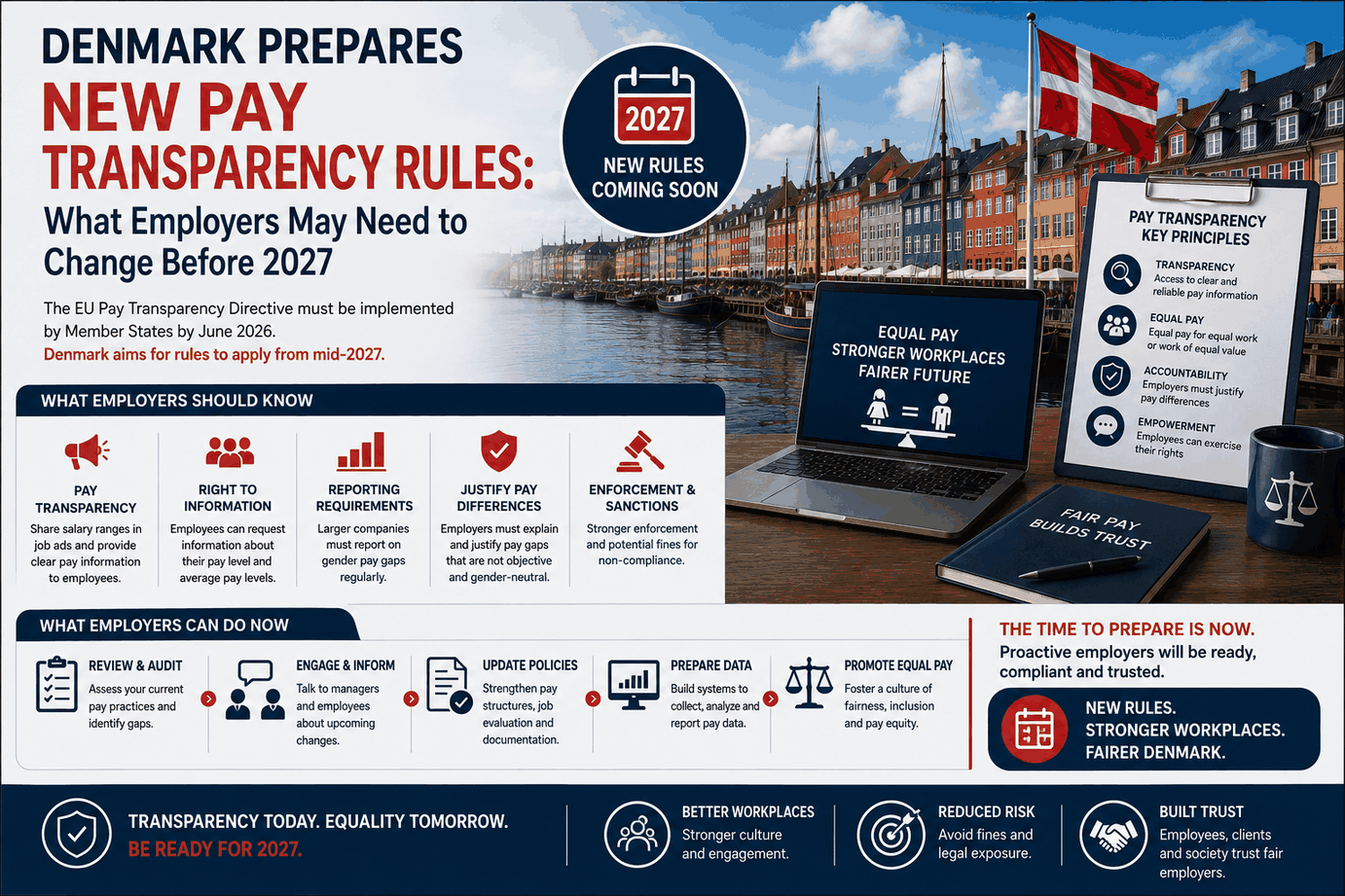
Danish employers could soon face a major change in the way they recruit employees, determine salaries and explain differences in pay.
Denmark is preparing legislation to implement the European Union’s Pay Transparency Directive, a major employment-law initiative designed to strengthen equal pay between women and men performing the same work or work of equal value.
The Danish Ministry of Employment and Gender Equality sent a draft amendment to the Equal Pay Act for consultation on February 26, 2026. The draft proposed that the new Danish rules take effect on January 1, 2027.
That would give employers additional preparation time compared with the EU’s original transposition deadline of June 7, 2026.
But questions remain about exactly what compliance will require in practice.
The issue returned to Denmark’s political agenda on August 28, when a parliamentary question asked the employment minister to explain what businesses would actually need to do to meet the proposed requirement that employees have easy access to the objective and gender-neutral criteria used to determine pay, pay levels and pay progression.
For employers, the debate is a reminder that pay transparency could require much more than publishing salary ranges in job advertisements.
Why Is Denmark Changing Its Pay Rules?
The changes originate from EU Directive 2023/970, adopted in 2023.
Its purpose is to strengthen the principle of equal pay between women and men for equal work or work of equal value.
European law has recognised equal pay for decades. The problem regulators are trying to address is that employees often lack enough information to know whether unequal treatment is occurring.
Two employees can perform comparable work while having little idea how their salaries compare.
The EU believes greater transparency can make unjustified differences easier to identify and challenge.
For employers, however, that means salary structures that have traditionally remained largely internal may need to become considerably more explainable.
Danish Employers Have Been Given More Time
EU member states were required to transpose the directive by June 7, 2026.
Denmark did not meet that deadline.
Instead, the Danish draft legislation proposes an effective date of January 1, 2027.
Danish employer organisation TEKNIQ described the delay as giving companies additional time to understand their obligations and prepare for the changes.
That extra preparation period could prove valuable.
Employers may need to examine job advertisements, recruitment procedures, salary-setting criteria, HR systems, employee classifications and gender pay data before the new framework takes effect.
The delay should therefore not necessarily be viewed as a reason to wait.
For many businesses, it may be an opportunity to find problems before greater transparency exposes them.
Salary Information Could Change Recruitment
One of the most visible changes concerns job applicants.
Under the EU rules, applicants must receive information about the initial salary or salary range for a position.
That information can be included in the vacancy notice or provided before the job interview.
The objective is to allow applicants to negotiate with greater information rather than entering salary discussions without knowing what the employer has budgeted for the position.
For Danish businesses, this could require changes to established recruitment practices.
Employers that currently advertise positions without mentioning compensation may need a process for determining an appropriate salary or range before recruitment reaches the interview stage.
That raises a practical question:
How wide can a salary range reasonably be before it stops providing meaningful transparency?
Employers may need to think more carefully about why two candidates for the same position could legitimately receive different offers.
Employers Should Not Ask About Previous Salary
Another significant change concerns salary history.
Under the EU directive, employers cannot ask applicants about their current pay or previous salaries.
This is intended to prevent historical pay differences from following workers throughout their careers.
Consider an applicant who was underpaid in a previous job.
If a new employer bases its offer on that person’s old salary, the earlier disadvantage can effectively be carried into the new workplace.
The new approach is designed to shift the discussion.
Instead of asking, “What did you earn before?” employers should focus on the value of the position, the applicant’s relevant qualifications and objective criteria used to determine compensation.
Recruiters and managers may therefore need updated interview procedures and training.
Pay Transparency Is Becoming a Corporate Compliance Question
The proposed changes are especially relevant to businesses following employment developments through Lead Roedl, whose employment practice includes advising Danish and foreign companies on employment in Denmark.
For international businesses, Denmark’s implementation also forms part of a wider European challenge.
The directive applies across the EU, but individual countries transpose its requirements into national law.
A multinational employer may therefore need an overall European pay-transparency strategy while still accounting for differences between national implementation regimes.
The legal issue also reaches beyond HR.
Payroll teams hold compensation data. Managers make promotion decisions. Finance controls salary budgets. Recruitment teams communicate with candidates.
Preparing for pay transparency may therefore require coordination across the organisation.
Employees Could Gain Greater Access to Pay Information
The changes do not stop when recruitment ends.
Workers will have stronger rights to information concerning pay.
Under the EU framework, employees can request information about their own individual pay level and average pay levels, broken down by sex, for categories of workers performing the same work or work of equal value.
Employers must also make criteria concerning pay levels and pay progression accessible.
This could expose weaknesses in salary systems that previously relied heavily on informal management discretion.
If two employees doing work of equal value receive substantially different salaries, the employer may need to explain the difference using objective, gender-neutral factors.
Potentially relevant factors could include experience, responsibilities, skills or performance where those criteria are genuinely connected to the job and applied fairly.
The important word is objective.
“We have always paid this employee more” is unlikely to be a convincing pay structure.
Denmark Is Still Debating What Employers Must Produce
The practical implications remain important enough to have reached Parliament again.
On August 28, a member of the Danish Parliament’s Employment Committee asked the employment minister what a company would concretely need to do to comply with proposed Section 1d of the legislation.
That proposed provision would require employers to make it easy for employees to access the objective and gender-neutral criteria used to determine their pay, pay levels and pay progression.
The parliamentary question specifically asks which documents businesses would be expected to prepare or complete.
As of the beginning of September, that question had not yet been answered.
For employers, this uncertainty matters.
A legal requirement to make salary criteria accessible sounds straightforward. Turning it into a working HR system can be considerably more complicated.
Companies may need job classifications, documented salary bands, promotion criteria or other records capable of explaining how compensation decisions are made.
Bigger Employers Face Pay-Gap Reporting
Reporting is another major part of the European framework.
Under the EU directive, employers with at least 100 workers fall within the pay-reporting system, although deadlines and frequency vary according to workforce size.
The information covered by the directive includes measures such as:
- Gender pay gaps
- Gender gaps in variable compensation
- Median gender pay gaps
- The proportion of men and women receiving variable compensation
- The distribution of male and female workers across pay quartiles
- Pay gaps within categories of workers performing the same work or work of equal value
The EU directive itself establishes different reporting schedules.
Employers with at least 250 workers are subject to annual reporting beginning in 2027.
Those with 150 to 249 workers report every three years beginning in 2027.
The directive provides a later 2031 starting point for employers with 100 to 149 workers, although national implementation can introduce requirements within the discretion permitted by EU law.
Danish employers should therefore pay close attention to the final Danish legislation rather than assuming the EU minimum rules will be copied word for word.
A 5% Pay Gap Could Trigger Further Action
One of the most consequential provisions concerns unexplained differences in pay.
Under the EU framework, a joint pay assessment can become necessary when reporting reveals a difference in average pay of at least 5% between female and male workers in a category, the employer cannot justify that difference using objective, gender-neutral criteria, and the difference is not corrected within six months.
That does not mean every 5% difference automatically proves discrimination.
There may be legitimate explanations for different salaries.
The challenge for the employer is being able to demonstrate those explanations.
Documentation therefore becomes crucial.
A company that has clear salary criteria and records explaining individual decisions will be in a stronger position than one where compensation has developed through years of informal negotiations and manager discretion.
“Work of Equal Value” May Be the Harder Question
Comparing two employees with identical jobs can be relatively straightforward.
The harder issue is determining when different jobs represent work of equal value.
EU rules require assessment based on objective, gender-neutral criteria.
Factors can include skills, effort, responsibility and working conditions.
That means employers cannot necessarily avoid comparisons simply because workers have different job titles.
A business may need to examine whether different roles actually demand comparable levels of responsibility, expertise or effort.
This could become particularly significant in organisations where traditionally male-dominated and female-dominated positions have developed under separate salary structures.
Smaller Employers Should Not Ignore the Changes
Much attention has focused on reporting requirements for larger businesses, but the directive is broader than corporate reporting.
Recruitment transparency and workers’ information rights can affect employers beyond those required to produce formal pay-gap reports.
A smaller Danish company may therefore avoid some of the most extensive reporting obligations while still needing to reconsider how it communicates salary information and determines pay.
This is why headcount should not be the only question employers ask.
The better question is which specific obligations apply to the business.
Foreign Employers in Denmark Need to Prepare Too
International businesses employing workers in Denmark should also follow the legislation closely.
A foreign parent company may already have a global compensation policy, but Danish employment requirements can still affect its local workforce.
This creates practical challenges for multinational employers.
Global salary grades may need to work alongside Danish job classifications. International HR systems may need to generate locally required information. Recruitment teams outside Denmark may need to understand that questions routinely asked elsewhere could be restricted when recruiting for Danish positions.
Companies operating across several EU countries may face similar rules arriving on different national schedules.
Coordination will therefore matter.
Pay Data Could Become Evidence
The directive also strengthens enforcement.
Workers who suffer gender-based pay discrimination can have rights to compensation.
Another significant feature concerns the burden of proof.
Where an employer fails to comply with certain pay-transparency obligations, the employer may have to demonstrate that discrimination did not occur.
This changes the risk calculation.
Weak documentation is no longer simply an administrative inconvenience.
It can make defending a pay discrimination claim more difficult.
Employers should therefore consider salary records, job classifications and compensation criteria as potential legal evidence.
What Should Danish Employers Do Before 2027?
Although the final Danish legislation is still developing, companies can begin preparing without predicting every detail.
Useful steps include:
- Map existing salaries and variable compensation
- Identify unexplained differences between comparable workers
- Review how jobs are classified
- Document objective salary-setting criteria
- Examine criteria for promotions and salary increases
- Review recruitment advertisements
- Stop relying on applicants’ salary history when setting offers
- Determine how salary ranges will be established
- Check whether HR systems can produce gender pay data
- Train recruiters and managers
- Review bonus and variable-pay structures
- Determine which reporting category the company is likely to fall into
- Follow the final Danish legislation and implementation timetable
Businesses should also examine how consistently existing policies are applied.
A beautifully written salary policy will provide limited protection if managers routinely ignore it.
Transparency Could Change Salary Negotiations
The cultural impact could be just as important as the legal one.
Salary negotiations have traditionally involved significant information imbalance.
Employers often know what everyone in the organisation earns. Employees generally know only their own salary and whatever colleagues voluntarily tell them.
Greater transparency changes that relationship.
Workers could enter salary discussions with more information about the structure around them.
That may encourage businesses to move from individual negotiation toward more systematic salary frameworks.
For employers already using clear salary bands and documented progression criteria, the transition may be relatively manageable.
For businesses relying heavily on individual negotiation, the adjustment could be much larger.
2027 May Arrive Faster Than Employers Expect
Denmark’s proposed January 2027 implementation gives businesses additional preparation time, but salary systems cannot always be redesigned quickly.
Employers first need reliable data. They need to determine which jobs are comparable, investigate unexplained differences, develop objective criteria and make sure managers understand how to apply them.
International employers face the additional task of coordinating Danish requirements with group-wide compensation policies.
And some details of Denmark’s final framework remain unsettled.
The parliamentary question submitted on August 28 demonstrates that even lawmakers are seeking greater clarity about what businesses will need to produce to demonstrate compliance.
That uncertainty is a reason to follow the legislation closely, but not necessarily a reason to postpone preparation.
Whatever form Denmark’s final rules take, the direction of travel is already clear.
Pay decisions are going to become more visible, more explainable and more dependent on objective evidence.
For Danish employers, the real preparation for pay transparency may therefore begin long before the first salary figure has to be reported.

Leave a Reply